

Craniosacral Therapy for Chronic Tension: A 2026 Guide
Table of Contents
Why Chronic Tension Doesn't Respond to Force
What Happens During Craniosacral Therapy
The Role of Cerebrospinal Fluid and the Craniosacral System
Dr. Upledger's Gentle Approach and Why Light Touch Works
Craniosacral Therapy and the Nervous System
Beyond the Central Nervous System: What Recent Research Is Looking At
Why This Matters for Chronic Tension Specifically
Fascial Unwinding: When Tissue Releases on Its Own Terms
Craniosacral Therapy Benefits for Headaches, Jaw, and Neck Tension
Headaches Are Not One Thing
Jaw Tension and the Clenching Cycle
How to Tell If It Is Working
What This Work Is Not
What Research Says About CST for Stress and Tension
Safety, Session Details, and What to Expect
Choosing a Practitioner and Comparing Your Options
Frequently Asked Questions
Why Chronic Tension Doesn't Respond to Force
Chronic tension is a nervous system output, not a mechanical defect, which is why pressing harder on a tight shoulder so often makes it tighter. Here is what craniosacral therapy actually does, what the research supports, and how to tell whether your body is asking for something gentler.
Force assumes the tissue is the enemy, but muscle guarding is a protective response, and the nervous system decides when to let go. You can override that decision briefly with enough pressure, but you cannot negotiate with it. That is why light touch sometimes outperforms deep work.
What Happens During Craniosacral Therapy
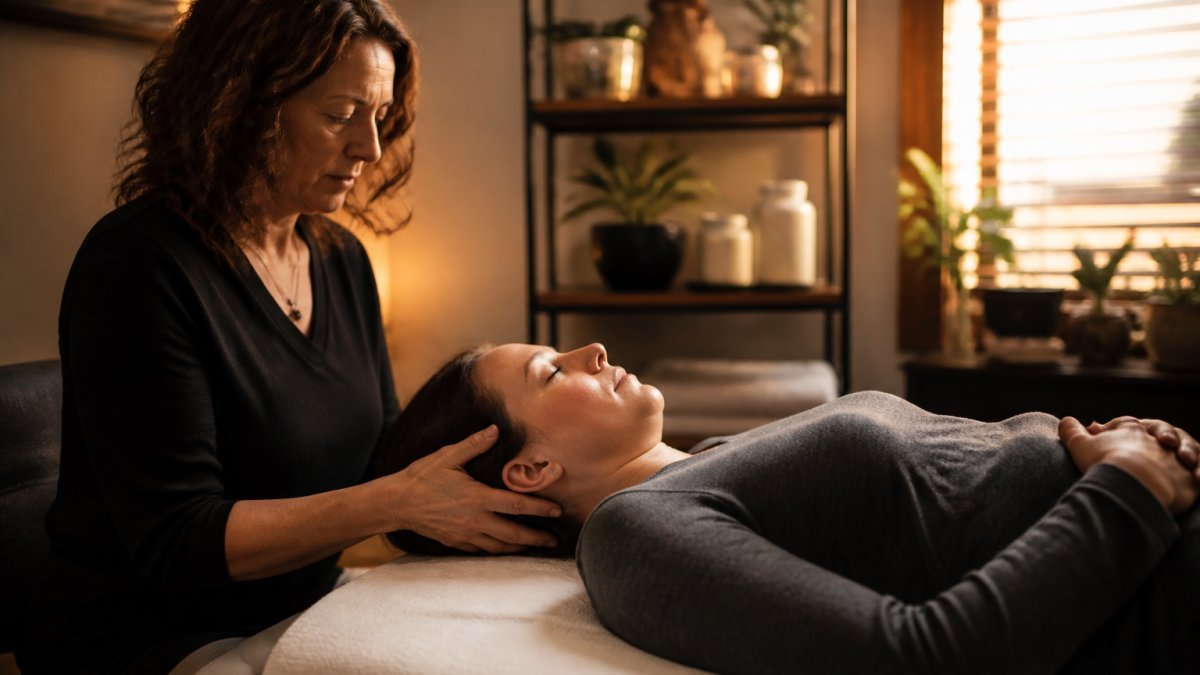
During a craniosacral therapy session, you remain fully clothed while the practitioner places hands lightly on the head, spine, pelvis, and sometimes the feet, waiting for tissue to respond rather than pushing into it. Sessions typically last 45 to 60 minutes. Nothing is forced; you are not required to do anything except breathe and notice.
The Role of Cerebrospinal Fluid and the Craniosacral System
The craniosacral system includes the membranes and fluid surrounding the brain and spinal cord. Cerebrospinal fluid bathes the central nervous system, and practitioners describe a subtle rhythmic movement in that fluid and the tissues around it. The rhythm can be measured. What matters practically is that the treatment targets the system governing protection and recovery, not just the muscle that hurts.
Dr. Upledger's Gentle Approach and Why Light Touch Works
Dr. John Upledger, the osteopathic physician who developed craniosacral therapy, built the method around a counterintuitive idea: the body's own correction is more durable than anything a practitioner imposes. His reasoning was that pressure above roughly five grams, about the weight of a nickel, triggers a defensive response rather than a release, so the therapist's job is to listen, not to win. When I work this way I’m slow and purposeful waiting for your body to respond instead of forcing my way in, which allows deep tissue results without the bracing that follows heavy-handed work.
Craniosacral Therapy and the Nervous System
Craniosacral therapy and the nervous system are inseparable, because the technique works primarily through the autonomic branch that governs heart rate, digestion, and muscle tone. Gentle, sustained contact appears to support a shift toward parasympathetic activity, the state in which repair and digestion happen, the same principle behind any effective relaxation practice, applied through touch.
Here is the part most articles skip. The autonomic nervous system does not act on muscle directly; it acts on the small muscles inside your blood vessels, gut, pupils, and hair follicles. When the sympathetic branch stays switched on, blood flow to connective tissue shifts, and the tissue becomes less hydrated and less mobile.
Beyond the Central Nervous System: What Recent Research Is Looking At
For decades, craniosacral therapy was explained almost entirely through the central nervous system and cerebrospinal fluid. Newer fascia research has shifted attention outward, toward the peripheral nerves and the connective tissue that wraps them.
Researchers studying manual therapy have proposed several mechanisms for why light, sustained contact might influence nerve behavior.
What makes this relevant to chronic tension is the timing. Nerve-related pain and tension often do not respond to force because force is itself a threat signal. If the tissue around a nerve is already sensitized, pressing harder can increase the protective response rather than release it.
Why This Matters for Chronic Tension Specifically
If your tension has been building for months or years, the nervous system has had a long time to practice it. That pattern is not stored in one muscle; it is stored in the relationship between the brain, the autonomic system, the fascia, and the nerves running through it.
This is also why I ask about sleep, light exposure, and what is on your plate. The autonomic system does not take a break between appointments.
Fascial Unwinding: When Tissue Releases on Its Own Terms
Fascial unwinding is the spontaneous, sometimes slow movement that occurs during a session as the body reorganizes tension patterns without deliberate direction from the practitioner. You may feel a limb drift, a subtle twist, or a wave of warmth. It looks passive. It is not.
What most guides miss is how unremarkable this looks from the outside and how significant it feels from the inside. A common mistake is treating a session as something to endure or optimize. The body's default program is to heal itself, and your only job is to give it what it needs. In craniosacral therapy it’s often referred to as the, “inner physician.”
Craniosacral Therapy Benefits for Headaches, Jaw, and Neck Tension
The most commonly reported craniosacral therapy benefits involve headaches, migraines, jaw tension, and neck and shoulder tightness, particularly when tied to stress and held tension patterns. What it does not tell you is why those four complaints cluster together, or how to tell whether the treatment is doing anything for you.
Start with anatomy. The trigeminal nerve, which carries sensation from your face, jaw, and much of your head, has connections into the upper cervical spine. The place that hurts is not always the place that needs attention.
Headaches Are Not One Thing
Tension-type headaches and migraines behave differently, and lumping them together is one reason people give up on treatment. Tension-type headaches tend to be bilateral, pressing, and mild to moderate, often tracking with postural load and stress, while migraines are typically one-sided, throbbing, and associated with light sensitivity, nausea, or visual changes. If your headaches are new, worsening, or accompanied by neurological symptoms, that is a physician conversation, not a massage appointment.
5 Helpful Tips For Stress Relief & Well Being →
Jaw Tension and the Clenching Cycle
People with jaw-related discomfort often describe less clenching and easier jaw movement after treatment. The mechanism is plausible: reduce sympathetic tone, and the muscles that guard the jaw have less reason to stay switched on. But clenching is often a sleep behavior, which means it happens during the hours you are not in the treatment room, so the session is working against a pattern that re-establishes itself every time you sleep. Sleep quality, evening light exposure, alcohol, and blood sugar stability all influence nocturnal clenching.
How to Tell If It Is Working
What is useful is picking two or three measurable markers before you start and tracking them honestly: headache days per month, how long it takes you to fall asleep, whether you wake with a clenched jaw, and how far you can turn your head before it catches. Write them down before your first session and check again after your fourth. If nothing has moved by six sessions, the approach may not be the right fit, and that is worth knowing rather than continuing out of habit.
What This Work Is Not
Craniosacral therapy is not a treatment for structural injury, and it does not replace medical care. It is not a solution for headaches caused by medication overuse, sleep apnea, or an untreated medical condition, nor a substitute for the inputs that shape your nervous system every day. What it can be is a way to interrupt a tension pattern that has become self-sustaining, and to give a nervous system that has been running hot a chance to downshift.
What Research Says About CST for Stress and Tension
Several small clinical studies and reviews have reported improvement in pain intensity and relaxation measures, while other reviews note small sample sizes, inconsistent protocols, and a real risk of bias.
What the research does support reasonably well is the stress and relaxation side. If you want to read primary sources rather than summaries, the craniosacral therapy association and the Upledger Institute are reasonable places to start.
Key Takeaway: The honest position on craniosacral therapy is this: the relaxation and stress-reduction effects are well reported and chronic pain evidence is promising but not settled. Use it as complementary care and keep your physician in the loop.
Safety, Session Details, and What to Expect
Craniosacral therapy is generally considered low risk because it involves light touch rather than forceful manipulation, but low risk is not no risk.
Here is what a reasonable treatment course looks like in practice:
First session: intake and history, then a full session focused on observation rather than correction
Sessions 2 through 4: addressing the tension patterns that showed up, spaced roughly one to two weeks apart
Reassessment: around session four, ask whether sleep, headaches, or jaw tension have changed measurably
Ongoing: if nothing has shifted by six sessions, the approach may not be the right fit for you
Measurable outcomes worth tracking are simple: how many headache days per month, how long it takes to fall asleep, whether you wake with a clenched jaw, and how far you can turn your head before it catches. Write them down. Information is useful, but knowing what to do with it is different.
Watch Out: The most common mistake I see is stacking aggressive deep tissue work, intense stretching, and high-stress training on top of a nervous system that is already overloaded. The consequence is a body that guards harder and a person who concludes they are beyond help. Gentle work is not weaker work.
Choosing a Practitioner and Comparing Your Options
Credentials vary widely, and this is worth checking before you book.
How does this compare with other approaches? Physical therapy tends to emphasize loading, strengthening, and graded movement, which is valuable for structural and post-surgical issues. Chiropractic focuses on joint alignment and mobilization.
I customize each session blending alignment, myofascial release, neurodynamics, and craniosacral therapy because most people do not need one technique. They need someone paying attention to the whole pattern. Even if you book a craniosacral therapy session with a history of headaches, I might ask if you’d like to add neck massage to your session. Honestly, it all depends what you tell me at the beginning of your appointment. How you describe the problem can tell me a lot and relying on my instincts I have ideas on what will help.
Chronic tension that has resisted every forceful intervention is worth investigating rather than enduring, and it is rarely the whole explanation it appears to be.
You can schedule a massage or craniosacral appointment here. For a more comprehensive session schedule a 2 Hour Purposeful Reset that addresses both systems.
Frequently Asked Questions
What happens during a craniosacral therapy session?
You remain fully clothed and typically lie on a massage table while the practitioner places light hands on areas like the head, spine, or sacrum. The touch is gentle, often no more than the weight of a nickel. Sessions usually last 45 to 60 minutes. Many people report deep relaxation, spontaneous tissue release, and sometimes emotional release as the nervous system settles. Your practitioner may also observe subtle rhythms in the craniosacral system to guide where attention is needed.
Can craniosacral therapy help with chronic muscle tension?
Craniosacral therapy addresses chronic tension by working with the nervous system and fascial network rather than forcing muscles to release. Research suggests CST may reduce pain intensity and improve relaxation by shifting autonomic function toward parasympathetic dominance. Because chronic tension often involves protective holding patterns, a gentle approach can reach restrictions that forceful work cannot. Results vary by individual, and CST is best used as part of a broader plan that may include other manual therapy and lifestyle factors.
How might craniosacral therapy affect the nervous system?
CST influences the autonomic nervous system by promoting parasympathetic activity, which supports relaxation, digestion, and tissue repair. Recent research indicates that CST may also affect peripheral nerves beyond the central nervous system, helping to reduce sympathetic tone and improve circulation. This shift can lower stress hormones and ease the tension patterns that contribute to headaches, jaw clenching, and neck pain. The effect is cumulative, often building over multiple sessions.
What is fascial unwinding during craniosacral therapy?
Fascial unwinding is a spontaneous release phenomenon where the body's connective tissue begins to move or release without the practitioner forcing it. During a session, you may feel subtle shifts, twitches, or a sense of tissues lengthening on their own. This happens because the gentle touch creates a safe environment for the nervous system to let go of long-held restrictions. Practitioners trained in craniosacral therapy recognize these cues and follow the body's lead rather than directing the release.
