

Why Does My Back Still Hurt After Physical Therapy?

Table of Contents
You Did the Work. So Why Does Your Back Still Hurt After Physical Therapy?
The Root Cause of Persistent Back Pain Often Lives Outside the Back
Why the Place That Hurts Is Rarely the Place That Needs Attention
Myofascial Release for Back Pain: What Hands-On Assessment Reveals
Compliance vs. Technique: When the Home Exercise Program Isn't the Problem
The Plateau, the Red Flags, and When to Ask Different Questions
Conclusion: A Different Question Leads to a Different Answer
Last Updated: Oct 1, 2026
You Did the Work. So Why Does Your Back Still Hurt After Physical Therapy?
You finished the sessions. You did the exercises at home, probably more than you were asked to. And your back still hurts. If you are asking why does my back still hurt after physical therapy, the honest answer is that a course of exercise rarely addresses everything feeding the pain. The work was real. The plan was just incomplete.
Here is the assumption worth questioning: that lingering pain means you failed.
It doesn't. It usually means the plan was built around the back itself.
The effectiveness of different massage techniques in the rehabilitation of patients with low back pain: August 2025, Journal of Education Health and Sport 84:65612, DOI:10.12775/JEHS.2025.84.65612
At six weeks, all massage modalities significantly reduced pain and disability compared with controls, with myofascial release producing the greatest improvements in functional outcomes and patient satisfaction. Classical massage and trigger point therapy also demonstrated clinically meaningful benefits, particularly in mobility and spasm reduction. Improvements were sustained at three and six months, with no serious adverse events reported. These findings support the integration of massage, and particularly myofascial release, into evidence-based rehabilitation protocols for patients with low back pain.
What Physical Therapy Can and Cannot Address
Physical therapy is genuinely useful for mechanical low back pain. It builds strength, restores range of motion, and teaches you how to move without fear.
But a course of care has limits. It runs for a set number of visits. It focuses on the region that hurts. And it rarely asks what else is going on in your life.
When the Protocol Is Built for the Average Body
Most clinics run on protocols. That is not laziness. It is how insurance billing and scheduling work.
The problem is that no one has an average body. Your hip rotation, your breathing pattern, your old ankle injury, and your sleep all shape how your back behaves. A protocol cannot see any of that.
The Root Cause of Persistent Back Pain Often Lives Outside the Back
The root cause of persistent back pain is frequently not in the back at all. It is in the inputs your body uses to repair itself every night.
Tissue healing needs raw materials and time. Take those away and the same exercises produce less.
Sleep, Stress, and the Recovery You Never Get
Deep sleep is when your body repairs connective tissue. Most adults do not get enough of it.
Add chronic stress and you get a nervous system stuck in a guarded, protective state. Muscles stay tight. Pain intensity rises. Central sensitization, where the nervous system amplifies signals, becomes more likely.
Food, Inflammation, and the Inputs You Control
Ancestral health principles offer a simple starting point: eat what your body recognizes as food.
Processed seed oils, refined sugar, and ultra-processed snacks drive inflammation. Many people also react to foods they eat daily without ever connecting the dots.
Pro TipTry a two-week elimination of one suspected food at a time, not five at once. One variable gives you a clear answer. Five gives you noise.
Why the Place That Hurts Is Rarely the Place That Needs Attention
Pain is a signal, not a location. The spot that hurts is often where the strain finally showed up, not where it started.
Myofascial Release for Back Pain: What Hands-On Assessment Reveals
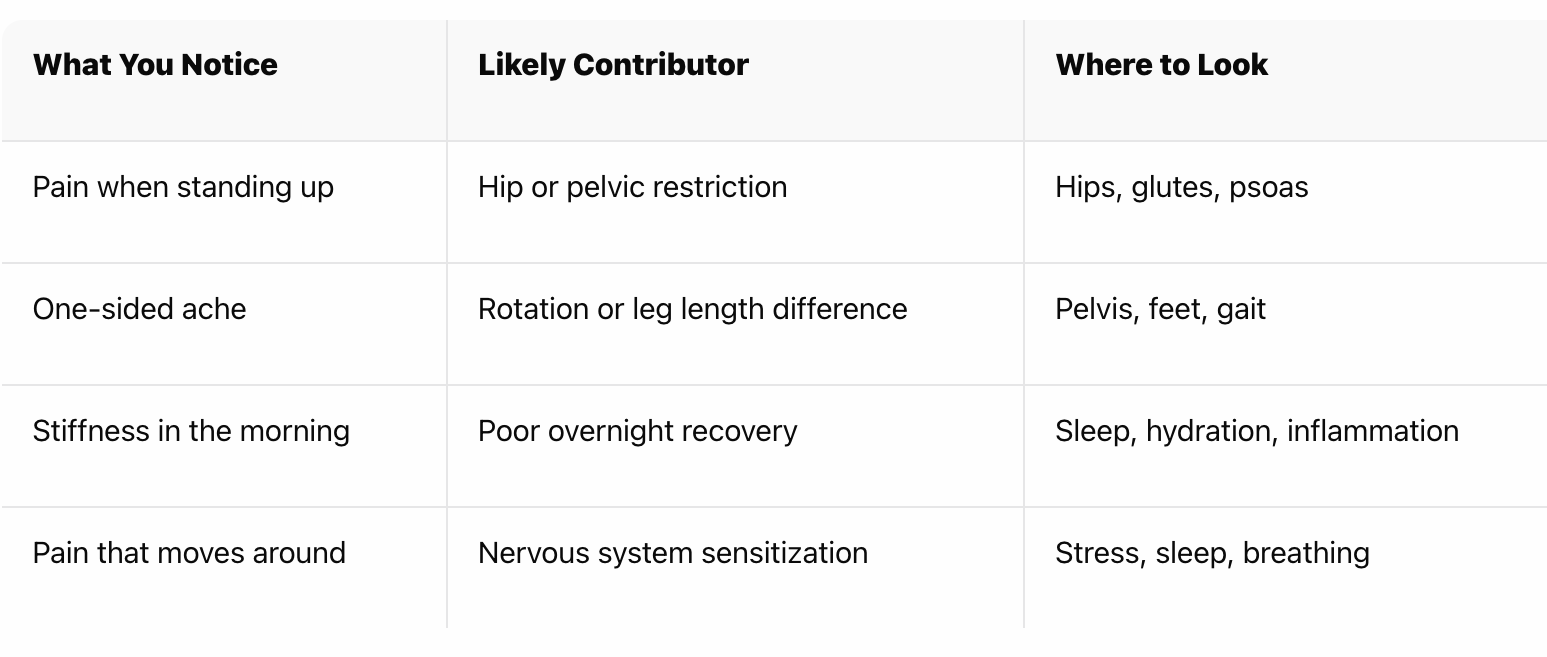
Infographic showing how myofascial release addresses “why does my back still hurt after physical therapy?”
Compliance vs. Technique: When the Home Exercise Program Isn't the Problem
Most people do the exercises. That is the part nobody gives them credit for. So when the pain lingers, the assumption becomes that they must have slacked off. Usually they did not.
Why You Cannot Feel Your Own Form
Your body has no reliable way to report its own position. The sensors in your joints and muscles tell you roughly where you are, but they adapt to whatever you do most often. If you have spent years standing with your weight shifted onto one hip, that stance feels neutral to you.
Schedule A Myofascial Alignment Session With Jen →
A few patterns show up again and again:
Bracing instead of breathing. Holding your breath to stabilize the spine spikes internal pressure and locks the ribcage down. The diaphragm stops doing its job, and the deep spinal stabilizers never get recruited.
Chasing range of motion. Pushing a stretch past the point where the joint can control it trains the nervous system to guard harder, not to lengthen.
Speed over control. Ten fast reps of a movement you cannot slow down is a rehearsal of the compensation, not the correction.
Compensating upstream and downstream. A hip that will not rotate sends the work to the lower back. A mid-back that will not extend sends it to the neck. The exercise gets done, just not by the tissue you intended.
Dosage Is Not a Suggestion
Three reps done with control can outperform fifteen done on autopilot. This is not motivational talk; it is how tissue adapts. Load applied with good mechanics signals the body to rebuild along those lines. Load applied through a compensation signals it to reinforce the compensation.
What Actually Fixes This
Ask your provider to watch you do the movements, not describe them. A single hands-on correction, a rib repositioned, a foot turned out two degrees, a breath cued at the right moment, can change which muscle does the work.
Pro TipFilm yourself from the side doing one rep of each exercise. Watch for breath-holding, a ribcage that stays rigid, and a pelvis that shifts instead of stabilizing. You will often spot the compensation before anyone else does.
The Part Nobody Measures
There is a reason a home program can be perfectly designed and still fail: the body repairs itself on its own schedule, using raw materials you either supply or do not. Sleep, daylight, unprocessed food, time barefoot on real ground, and time away from screens all feed the system doing the rebuilding.
The Plateau, the Red Flags, and When to Ask Different Questions
The plateau is real, and it is the most discouraging part of the whole process. You improve for a few weeks. Then the line goes flat. You keep doing the same work and nothing changes.
That flat line is information, not failure.
Why Progress Stalls
Early gains after an injury come from several places at once: swelling resolves, the nervous system stops guarding quite so hard, and confidence returns. Those improvements happen fast and they feel like progress.
What to Do at a Plateau
First, widen the lens before you add intensity. More reps of the same movement rarely breaks a plateau that was caused by something outside the movement.
Ask:
Has anything changed in my sleep, stress, or food in the last month?
Am I breathing into my belly during the exercises, or holding my breath?
Has anyone actually watched me move, or am I working from a description?
Is there a restriction somewhere else, hip, mid-back, foot, jaw, that nobody has checked?
Red Flags: When to Stop and Get Evaluated
Some symptoms are not a plateau. They are a signal to see a physician promptly, before any bodywork:
New or severe pain that wakes you at night
Numbness in the groin or saddle area
Loss of bladder or bowel control
Progressive weakness in one or both legs
Pain following a fall, accident, or impact
Unexplained weight loss alongside back pain
Fever, chills, or night sweats with back pain
A history of cancer with new back pain
The Gray Zone
Watch OutIf you have new, severe, or progressive symptoms, see a physician before booking any bodywork. Massage complements medical care. It does not replace it.
If you have been cleared medically and the plateau is holding, schedule a massage appointment with Jennifer in Meridian, Idaho for a hands-on assessment of what the exercises may have missed. You can also explore The Other 23 for the hours outside your session, or visit the Field Guide to keep learning.
Conclusion: A Different Question Leads to a Different Answer
So here is the question worth sitting with: what if the problem isn't that you need to try harder? What if you need to look at the problem differently?
Frequently Asked Questions
How do you know when physical therapy is not working?
A common signal is a plateau: you have completed several weeks of sessions, kept up with your home exercises, and your pain intensity or function has stopped improving. Some soreness after sessions is normal, but pain that steadily worsens, spreads, or keeps you from daily activities is worth a conversation with your provider. New, severe, or progressive symptoms such as numbness, weakness, or loss of bladder or bowel control need prompt medical evaluation rather than more exercises.
What factors beyond exercise influence chronic back pain?
Exercise is one input among many. Sleep quality, stress, nutrition, daily posture, how you sit and lift, and even how your hips and mid-back move all shape what your spine deals with. When the root cause of persistent back pain sits in one of these areas, a course of therapeutic exercise alone may not resolve it. That is why a broader look at habits, recovery, and whole-body patterns often explains why the back still hurts after physical therapy.
How does myofascial release for back pain differ from standard physical therapy?
Physical therapy often focuses on strengthening, range of motion, and movement retraining. Myofascial release for back pain works directly on the soft tissue: the fascia, muscles, and connective layers that may be holding tension and limiting joint mobility. Hands-on assessment can reveal restrictions in areas like the hips or mid-back that never showed up in a standard protocol. The two approaches can complement each other rather than compete.
Can physical therapy make pain worse before it gets better?
Mild soreness for a day or two after a session can happen as tissues adapt to new demand. What matters is the trend. If pain keeps climbing session after session, or symptom exacerbation lasts longer each time, that is a sign the current plan may need adjusting. Bring it up with your therapist or physician. Persistent or worsening pain is not something to push through, and it may point to a factor the program is not addressing.
