


Table of Contents
The Constant Feeding Assumption and Why It Deserves Questioning
How Autophagy Works: Cellular Recycling Under Nutrient Sensing
Autophagy and Insulin Sensitivity: Where the Mechanism Meets Metabolism
Autophagy Fasting Duration: What Human Studies Actually Measure
Signs of Autophagy: Why You Cannot Feel It and What Markers Exist
Metabolic Flexibility and Autophagy: Building the Capacity to Switch
Your Next Step: Testing Your Own Metabolic Response Before Chasing Fasting Windows
Frequently Asked Questions
The Constant Feeding Assumption and Why It Deserves Questioning
Most of us were raised on the idea that the body needs a steady supply of food to keep running. Eat breakfast, snack by mid-morning, eat lunch, and never let your blood sugar drop too far. That rule deserves questioning, because the body has other jobs to do besides digesting.
When the body is not busy digesting, it has room for housekeeping. One of the most important of those jobs is autophagy, a process where cells break down and recycle their own worn-out parts. The word comes from Greek roots meaning "self-eating," which sounds dramatic but describes something quite ordinary.
Our ancestors did not eat on a fixed schedule. They went through long stretches between meals, especially when food was scarce or the seasons changed. Constant feeding is a modern pattern, and it may be one reason the cellular cleanup crew rarely gets a shift.
How Autophagy Works: Cellular Recycling Under Nutrient Sensing
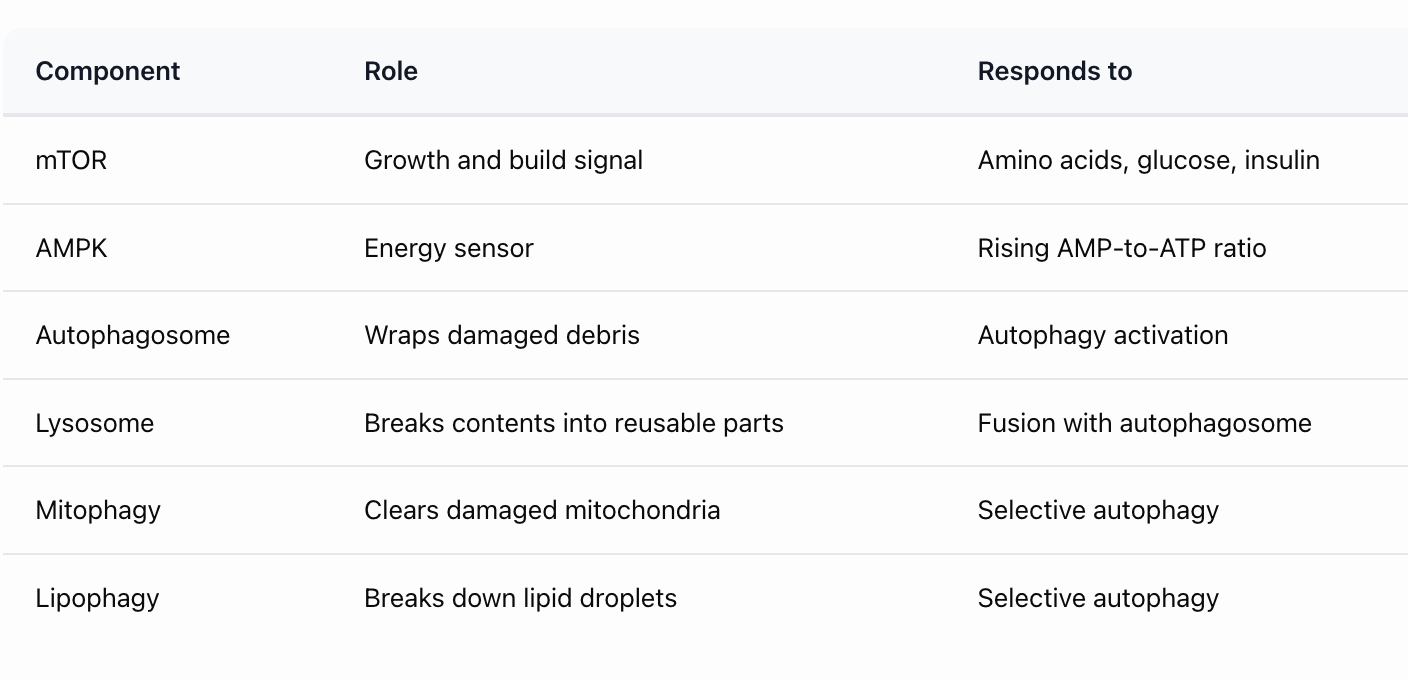
Autophagy is the cell's recycling system, and the basic choreography is worth knowing because it explains why the process is so tightly tied to what and when you eat. Damaged proteins, worn-out mitochondria, and other debris get wrapped in a double-membrane structure called an autophagosome.
The word comes from Greek roots meaning "self-eating," which sounds alarming until you realize this is ordinary maintenance, the cellular equivalent of tearing down a failing outbuilding to salvage the lumber. What matters for autophagy metabolic health is the control system that decides when the crew gets to work.
Two kinase complexes sit at the center of that decision. mTOR, mechanistic target of rapamycin, is the growth-and-build signal. When amino acids, glucose, and insulin are plentiful, mTOR is active and pushes the cell toward synthesis and away from recycling. AMPK is the energy-sensor counterpart.
That push-pull is why insulin and autophagy are so intertwined. Insulin is one of the strongest suppressors of autophagy in laboratory work, largely through its activation of mTOR.
What most popular explanations leave out is that autophagy is not one uniform process. It is selective, and the selectivity is where metabolic health gets interesting:
Mitophagy clears damaged mitochondria. This matters because failing mitochondria produce reactive oxygen species and impair fat oxidation, a direct link between autophagy and metabolic flexibility.
Lipophagy breaks down lipid droplets, releasing fatty acids for beta-oxidation. In liver and adipose tissue, this is one route by which fasting mobilizes stored fat.
Aggrephagy and ribophagy handle misfolded protein aggregates and worn-out ribosomes, which is part of why autophagy is studied so heavily in aging and neurodegeneration.
Xenophagy targets intracellular pathogens, which is why the immune system and autophagy overlap more than most people realize.
Tissue context changes the picture further. The liver runs high baseline autophagy and responds quickly to fasting, which is one reason hepatic insulin resistance and fatty liver are so tightly linked to impaired autophagic flux.
Autophagy pathway overview and ATG protein function
The basic steps and control signals are easier to scan side by side, so here is how the process runs and what sets it off.
Autophagy and Insulin Sensitivity: Where the Mechanism Meets Metabolism
Insulin and autophagy have a well-documented push-and-pull relationship in laboratory work. High insulin signaling tends to suppress autophagy, while lower insulin levels allow it to proceed. In practical terms, a body that spends long periods with lower insulin has more opportunity for recycling.
Insulin sensitivity matters here as well. Cells that respond well to insulin do not need to pump out as much of it to clear glucose. A metabolic system that is working well moves smoothly between fed and fasted states instead of staying locked in one mode.
Autophagy Fasting Duration: What Human Studies Actually Measure
Personalization is where this topic gets genuinely practical. Age matters: autophagy capacity tends to decline with age, and older adults, particularly women in perimenopause and menopause, have to weigh any fasting strategy against muscle preservation and bone health, which is why adequate animal protein and resistance training belong in the same conversation.
There can be another struggle in conducting a human studies. How did that person eat, exercise, and sleep before the study? Are they fat adapted, or have they been living on the Standard American Diet and Lifestyle? Each of these affect how your cells will respond to intermittent fasting.
This is where I help people adopt a low carb lifestyle gradually and help them learn how to incorporate intermittent fasting. Years ago intermittent fasting became trendy, for good reason, but I found most people don’t understand the point — autophagy. Eavesdropping on conversations, the general takeaway is that people are simply starving themselves with gusto.
When you’re fat adapted fasting becomes much easier because your body remembers how to access body fat for energy. Years of eating the modern diet has switched that off, but it’s possible to get it back.
Male physiology is more tolerant to some of these extremes. For women, daily fasting typically creates hormonal dysfunction. This is because they combine fasting with the idea that they need to eat less as well. Your body needs nutrients to function and when you’re not taking in enough things begin shutting down. If you can eat 2,000 calories in one sitting you might be able to get away with OMAD (one meal a day), but I find that most women don’t have that appetite.
A more practical approach is to stop chasing the hour count and start tracking the signals that actually reflect metabolic health: fasting glucose, waist circumference, energy stability between meals, sleep quality, and strength in the gym. If weight efforts keep stalling, common reasons weight loss didn't work explains what often gets in the way.
Signs of Autophagy: Why You Cannot Feel It and What Markers Exist
Many people hope to feel autophagy working, perhaps as a surge of energy or a clearer head. Nobody can feel cellular recycling directly. It happens at a level far below sensation. The degree of hunger pangs and irritability are greatly influenced by sleep, metabolic health, and your recent dietary choices.
Researchers use laboratory markers such as LC3 and p62 in tissue samples, but these require biopsies and specialized testing. They are not something a person can check at home or ask a clinic to run casually.
What you can observe are the broader signals that often travel with a metabolic shift. Steadier energy between meals, fewer sugar cravings, and changes in waist size or fasting glucose readings are reasonable things to track over time. These show how your body responds to your habits. They do not prove autophagy is occurring.
Metabolic Flexibility and Autophagy: Building the Capacity to Switch
The more useful goal may be metabolic flexibility, which is the ability to move between burning glucose and burning fat without a crash. A flexible metabolism handles a skipped meal, a long hike, or a carbohydrate-heavy dinner without much drama.
Ancestral eating patterns tend to support this flexibility. Adequate animal protein, healthy fats, whole plant foods, and fewer refined sugars give the body steady fuel. Over time, that steadiness may make it easier to go longer between meals without feeling depleted.
Start with the meal you already eat most consistently. Notice whether you feel stable two to four hours after eating, and whether a longer gap between dinner and breakfast leaves you foggy or fine. Those observations tell you more about your own biology than any generic fasting chart.
A simple tool to gauge your fasting ability is to fast after dinner. That means no snacks before bed and then don’t eat the next morning until you feel hungry. Be mindful that coffee is an appetite suppressant even when it’s black. Adding cream and any sort of sweeteners will turn autophagy off. Simply note the hours.
As you adjust your diet and lifestyle and repeat the fasting test above, the length of time before you feel hungry again should increase.
Sleep and light affect fasting too. Many people who struggle with late-night eating also struggle with sleep, and the two can feed each other. A diet change for better sleep shows how the foods you eat affect how well you rest. Morning daylight, consistent sleep timing, and an earlier last meal often make a meal-spacing change feel more manageable.
Your Next Step: Testing Your Own Metabolic Response Before Chasing Fasting Windows
Before adopting any fasting schedule, it helps to know how your body is actually handling food right now. Keep a simple log for two weeks. Record when you eat, what you eat, how energy feels mid-afternoon, how well you sleep, and whether you get cravings or energy crashes.
If you feel hungry between meals your last meal failed you.
You either
Didn’t eat enough calories.
Didn’t eat enough nutrients.
Bring that log to a conversation with a health coach who understands metabolic health. A tips to lose weight and balance hormones episode covers related starting points. Health coaching can help you interpret what your body is telling you. I can help you investigate your own patterns instead of following someone else's protocol. Together we’ll interpret what your body is telling you and decide what to test next, with attention to any medications or health conditions you have. (a critical piece)
Start with the data you already have, and let your own response guide the next move.
Frequently Asked Questions
How long do you need to fast for cell autophagy?
Human data on this is thinner than most popular articles suggest. Much of the work showing autophagy-related changes comes from cell and animal models, and the timing in people varies with age, activity, metabolic health, and what someone ate beforehand. Some human studies have looked at changes in markers after overnight fasts and longer fasts of roughly 24 to 72 hours, but a single duration cannot be presented as a switch that flips at a fixed hour. Treat any specific hour count as a rough research reference, not a target, and watch how you feel and perform during longer fasts.
Can you tell when your body is in autophagy?
Not reliably by feel. People often report feeling clearer or less hungry during fasting, but those sensations do not confirm that autophagy is happening, and they are shaped by many other factors including blood sugar, sleep, and stress. In research settings, autophagy is assessed with tissue or blood markers that are not practical for everyday use. A more useful approach is to track fasting tolerance, energy, sleep quality, and how your body responds to meal timing over several weeks.
Do you still burn fat during autophagy?
Yes. Autophagy is a cellular recycling process and does not replace fat oxidation. During fasting, lower insulin and rising glucagon shift the body toward fat and ketone use for fuel while cells also clear damaged components. The two processes run alongside each other. Whether fat loss results from a given fasting pattern depends on total intake over time, not on autophagy alone.
