


Table of Contents
The 3 A.M. Wake-Up Call Your Joints Are Sending
How Sleep Deprivation and Inflammation Feed Each Other
Cytokines, Melatonin, and the Night Shift Inside Your Body
Where the Evidence Gets Murky
Why Poor Sleep Makes Joint Pain Feel Worse
Inflammatory Pain vs. Positional Pain: Telling Them Apart
Foods That Disrupt Sleep, Inflammation, and Joint Comfort
Circadian Rhythm and Inflammation: Light, Timing, and Recovery
Sleep Hygiene for Chronic Pain: A Practical Plan
When to Look Beyond Sleep and Seek Help
Start Investigating Your Sleep and Pain With Jennifer
Frequently Asked Questions
The 3 A.M. Wake-Up Call Your Joints Are Sending
It is 3 a.m. again. You shift your hip, and a dull ache answers back. You roll over, and your shoulder joins the conversation. By morning, everything feels stiff, and you write it off as another night of bad sleep.
But what if that 3 a.m. wake-up is not random? What if sleep and joint pain are a two-way street, and your body is using the quiet hours to tell you something?
I have been licensed by the Ohio State Medical Board to practice medical massage therapy since 2002. People blame their age for the ache and rarely ask what their sleep has to do with it.
Below, I will walk through the biology of sleep and inflammation, why pain feels louder after a rough night, and a practical plan you can start tonight.
How Sleep Deprivation and Inflammation Feed Each Other
Sleep deprivation and inflammation run in a loop. Poor sleep turns up inflammatory signaling, that signaling makes sleep worse, and the cycle tightens night after night. Most articles imply a simple cause and effect; the honest version is messier, and the mess is where the useful questions live.
Start with what is well established. Research on sleep and immune function from the National Institutes of Health describes this shift, and it is one of the more consistent findings in the field.
Here is the loop in plain terms:
Short or fragmented sleep raises inflammatory signaling
Higher signaling increases pain sensitivity
More pain fragments your sleep
Fragmented sleep raises signaling again
You can see why treating only one end rarely holds, and why the relationship is best described as bidirectional rather than causal in one direction. If you have ever had a bad night and a worse knee the next day, you have felt the loop without needing a study to prove it.
Cytokines, Melatonin, and the Night Shift Inside Your Body
Inflammatory cytokines are signaling proteins your immune system uses to coordinate repair, and two you will hear about often are interleukin-6 (IL-6) and tumor necrosis factor alpha (TNF-α). During healthy sleep, these rise and fall in a rhythm; when sleep is cut short, that rhythm flattens and signaling can stay elevated. The rhythm matters as much as the level, which is why "eight hours" is a crude target.
Melatonin is not just a sleep hormone; it interacts with immune regulation, and its release depends on light and timing. When light pushes melatonin off schedule, the whole night shift runs late. The evidence is strong for a connection and less settled on exact mechanisms, so treat mechanism claims with caution.
Where the Evidence Gets Murky
Much of the human research on sleep and inflammation is observational, showing association rather than proof of direction. People with chronic pain often sleep poorly for reasons unrelated to their joints, including medications, mood, sleep apnea, and metabolic health, and those factors can drive both poor sleep and higher inflammatory markers.
That does not make the loop less real, just more interesting. If several inputs feed the same fire, changing the right one may matter more than changing all of them. Osteoarthritis, inflammatory arthritis, and other joint conditions may interact with sleep differently, and a single explanation rarely fits everyone.
So the better question is not "does sleep cause inflammation." It is "what is driving my sleep, and what is driving my pain, and where do they overlap." If you want a broader guide to investigating your own inflammatory triggers beyond just sleep, learn how to manage inflammation naturally.
Why Poor Sleep Makes Joint Pain Feel Worse
Pain sensitivity rises when sleep is short, one of the more consistent findings in this area. It explains why the same knee can feel manageable at noon and unbearable at 3 a.m.
Your brain does not process pain like a simple alarm. It weighs the signal against context, fatigue, and threat. Sleep loss tips that weighing process toward "more." A study summarized by the Sleep Foundation on sleep and pain describes how even partial sleep deprivation can lower pain threshold and raise pain intensity. So the joint may not have changed much. Your interpretation of it has.
This is where I push back on the usual advice. Most people try to fix the joint and ignore the sleep. In practice, the two move together, and the place that hurts is not always the place that needs attention.
Inflammatory Pain vs. Positional Pain: Telling Them Apart
Inflammatory pain tends to bring morning stiffness, warmth, and swelling that eases as you move. Positional pain shows up after you have been in one spot too long and improves when you shift. Both can wake you, but they point in different directions.
Ask yourself:
Is the pain worst on waking and better after an hour of movement? That leans inflammatory.
Does it move with your sleep position and settle when you change it? That leans mechanical.
Is it in the same joint every night, or does it wander? Wandering pain deserves a closer look.
This distinction is not a diagnosis. It is a set of better questions to bring to your provider and to your own investigation.
Foods That Disrupt Sleep, Inflammation, and Joint Comfort
Some foods disrupt sleep, and the same foods can nudge inflammation and joint comfort in the wrong direction. That overlap is why a food diary is one of the most useful tools I recommend.
Here are the usual suspects worth watching:
Late, heavy meals that keep digestion working when your body wants to rest
Alcohol, which helps you fall asleep and then fragments the second half of the night
Caffeine after early afternoon, which lingers far longer than most people expect
Seed oils and fried foods, high in linoleic acid, which may add to oxidative stress
Added sugar, which can spike and crash blood sugar overnight
Then there are the plant compounds. Nightshades, oxalates, phytates, lectins, and histamines do not bother everyone, but they bother some people in ways that show up as joint aches and worse sleep. My article on plant compounds that may be causing your joint pain walks through which ones to watch, and changing your diet for better sleep gives you a starting point.
Watch out: cutting many foods at once makes it nearly impossible to tell what helped. Change one thing at a time.
Circadian Rhythm and Inflammation: Light, Timing, and Recovery
Circadian rhythm and inflammation are tied to light and timing. Your body expects bright light in the morning and darkness at night, and modern life delivers almost the opposite.
Morning sunlight sets the clock that governs melatonin release, cortisol timing, and immune activity. At night, bright screens and overhead light tell your body it is still daytime, and melatonin release waits.
The National Institute of General Medical Sciences on circadian rhythms explains how these internal clocks influence far more than sleep. When timing drifts, recovery drifts with it. Grounding, time outdoors, and consistent light cues are not fringe ideas; they are signals your biology has expected for a very long time.
Sleep Hygiene for Chronic Pain: A Practical Plan
Most sleep advice for chronic pain reads like a list of rules copied from a hotel nightstand.
Start with duration. Most adults need seven to nine hours. If you are concerned about your sleep, consider what questions you might bring to a qualified professional.
Then separate quantity from quality. Time in bed is not time asleep, and time asleep is not the same as restorative sleep.
Treat sleep as an investigation, not a prescription.
Set a fixed wake time, seven days a week, and let bedtime follow from it
Get outside within an hour of waking for natural light, no sunglasses
Dim indoor lights two hours before bed and reduce overhead lighting
Stop caffeine by early afternoon, since it lingers longer than most people expect
Finish eating two to three hours before sleep, and notice whether late meals change your night
Cool the room and darken it fully, including small standby lights
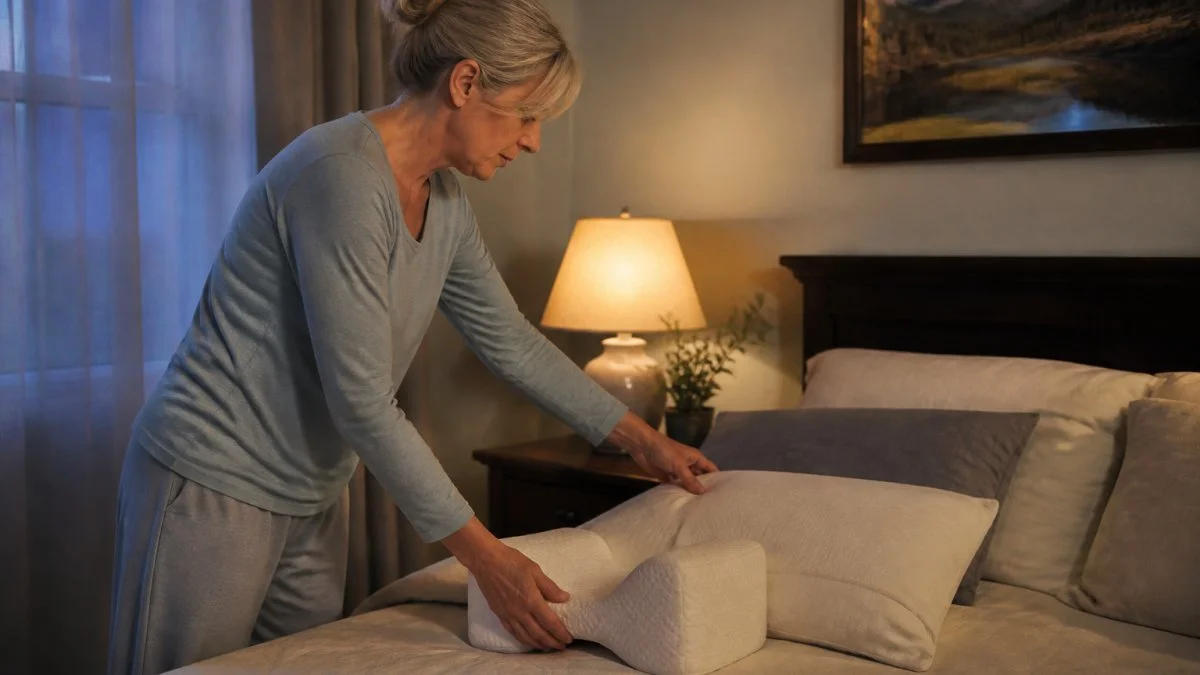
Use pillows to support hips, knees, and shoulders in your sleep position
Keep a two-line note each morning: how you slept, where you hurt
Information is useful; knowing what to do with it is different.
Pro Tip: If you want a simple measure, track three things only: hours slept, awakenings, and morning pain. More data is not better data when you are tired.
Sleep is one part of a broader investigation. A qualified professional can help you consider what may be relevant to your individual situation.
If you want to learn more, the The Other 23 Field Study is a 16-week small-group health coaching and bodywork experience for women 40+.
When to Look Beyond Sleep and Seek Help
Sleep is one part of the picture, not the whole picture. Some joint pain has causes that sleep changes will not touch, and knowing when to look further is part of investigating well.
Look beyond sleep when you notice:
Redness, heat, or swelling in a joint that persists
Morning stiffness lasting more than an hour, day after day
Pain that wakes you every night regardless of position
Symptoms in many joints at once
Fevers, unexplained weight loss, or rashes alongside joint pain
Snoring, gasping, or daytime exhaustion that suggests a sleep disorder
Rheumatoid arthritis and other rheumatic diseases deserve evaluation by a qualified professional. So do sleep disorders like sleep apnea, which fragment sleep and drive inflammatory signaling on their own. Medications can confound the picture too; some affect sleep, and some affect pain reporting. Conventional care has real value here, and it can still leave questions unanswered when appointments are short and care is fragmented. My role is to help you ask better questions, not to replace your medical team.
Start Investigating Your Sleep and Pain With Jennifer
Here is the challenge I will leave you with. For the next two weeks, treat sleep and joint pain as one investigation instead of two separate complaints. Note what you ate, how you slept, and where you hurt. Then consider what questions your experience raises.
If the answer points toward individualized attention, I would be glad to help. My bodywork uses slow, purposeful strokes, waiting for your body to respond rather than forcing my way in. I combine that with alignment work, myofascial release, and craniosacral therapy, and I look at the whole person rather than only the spot that hurts. Hands-on care is HSA accepted, and I provide educational resources to support long-term health habits.
Maybe it is not your age. Your experience is worth investigating, and better questions can lead to better understanding. Schedule an appointment and let us get curious about what your body has been trying to tell you.
Frequently Asked Questions
Can poor sleep make joint pain worse?
Sleep and joint pain are topics worth discussing with a qualified professional. Your experience is worth investigating, and better questions can help you explore what may be relevant to your situation.
What foods may interfere with sleep?
Food choices are one topic you could discuss with a qualified professional. Your individual experience is worth investigating.
How can I improve sleep quality when joint pain keeps me awake?
If joint pain is affecting your sleep, consider discussing your experience with a qualified professional. The pattern and context of your symptoms are worth investigating.
When should I seek medical help for persistent joint pain or sleep problems?
Questions about persistent joint pain or sleep problems are appropriate to discuss with a qualified medical professional. Jennifer’s role is to encourage investigation, not to replace necessary medical care.
Your Body, Decoded
Your Body Isn't Broken. It May Just Need Something Different.
What if the stiffness, fatigue, cravings, aches, and changes you've been blaming on getting older are actually clues that your body needs a change?
You're 40+. Maybe 50+. Maybe 60+.
And somewhere along the way, you've started hearing the same explanation:
“That's just what happens as you age.”
Your joints hurt.
You're tired when you shouldn't be.
Your sleep isn't what it used to be.
Your weight doesn't respond the way it once did.
You have aches and pains that seem to have taken up permanent residence.
You've tried diets.
You've tried eating “healthy.”
You've probably tried exercising more.
And yet...
You don't feel healthy.
I'm here to tell you that getting older doesn't automatically mean you have to accept feeling older.
You Don't Need Another Diet.
You need someone who can help you make sense of the noise.
There is no shortage of nutrition advice.
Eat this.
Don't eat that.
Count this.
Track that.
Exercise more.
Eat less.
Ignore your cravings.
Try the newest superfood.
And if that doesn't work?
Apparently you just need more willpower.
I don't buy it.
My approach is different.
I don't hand you a meal plan and tell you what you're “allowed” to eat. I don't tell you to count calories or punish yourself with exercise.
Instead, I educate you.
I help you understand why your body may be responding the way it is, what influences your metabolism and hormones, and how nutrition, movement, sleep, stress, sunlight, recovery, and your daily environment work together.
My coaching is rooted in species-appropriate nutrition and lifestyle—not the latest diet trend and not a one-size-fits-all prescription.
Think of me as your translator.
The internet is full of information.
Some of it is excellent.
Some of it is outdated.
Some of it is sponsored by someone trying to sell you something.
And some of it is just... confidently wrong.
You shouldn't have to become a nutrition researcher just to figure out what to eat for breakfast.
That's where I come in.
I'll help you separate useful information from noise, understand the science behind the recommendations, and figure out which changes make sense for your goals and your life.
You remain in charge.
I provide the education, experience, perspective, and guidance.
I Don't Tell You What to Do.
I help you understand what your choices can do.
That's an important distinction.
You decide what you're willing to change.
You decide what matters to you.
You decide which habits you're ready to tackle.
My job is to help you understand the likely consequences of those choices, give you the information you need to make informed decisions, and help you troubleshoot when something isn't working.
No shame.
No food police.
No “you fell off the wagon.”
And definitely no starting over every Monday.
We're building something you can actually live with.
What We Look At
Your health doesn't happen in a vacuum.
Food matters—but it's not the only thing that matters.
Depending on your goals, we'll explore the lifestyle factors that can influence how you feel, including:
Nutrition and metabolic health
Blood sugar and cravings
Sleep and recovery
Stress and nervous-system load
Movement and strength
Daily activity—not just your workout
Sunlight and time outdoors
Circadian rhythms
Hydration and minerals
Your relationship with food
Habits that support long-term consistency
Because what you do for one hour at the gym doesn't erase what your body experiences during the other 23 hours of the day.
Your health is happening all day.
Let's work with all of it.
I've Seen What Can Happen When Someone Stops Accepting “This Is Just Aging.”
I've worked with people struggling with joint pain, autoimmune issues, weight, energy, mood, cravings, and the frustrating feeling that their body simply isn't cooperating anymore.
I've watched people in their 70s make significant changes in their pain and wellbeing through changes in food and lifestyle.
I've also worked with someone who had been through two failed back surgeries and was facing another surgery—but first needed to lose 50 pounds.
She was a single mother with two children, dealing with severe physical limitations and restrictions on what she could lift.
We changed the way she was eating.
She lost 50 pounds in five months—four months sooner than her doctor anticipated.
Later that year, she was able to have the surgery she needed.
Today, she's out racing bicycles.
That's not a promise of what will happen for you.
It's an example of what's possible when someone stops assuming that their current condition is the only condition available to them.
Your First Step Is Free.
Before you purchase a coaching package, we'll spend 30 minutes together at no cost to you.
This isn't a sales pitch disguised as a consultation.
It's an opportunity for us to talk.
I'll learn where you are now, what you've tried, what seemed to work, where things fell apart, what you're struggling with, and—most importantly—what you actually want to change.
We'll talk about whether coaching makes sense for you and what kind of support you may need.
If I believe I can help, I'll explain how.
If I don't think I'm the right person for you, I'll tell you that, too.
How Long Will You Need Me?
Some people need a little guidance.
Others have spent years trying to figure this out and need more time, education, troubleshooting, and support.
That's why I offer 4-, 8-, and 12-week coaching packages.
The principles don't change.
The amount of time you have to practice, learn, adapt, and build confidence does.
After our initial conversation, I'll help you determine which level of support makes the most sense for where you are right now.
This Isn't About Becoming Perfect.
It's about becoming less confused.
More capable.
More informed.
More connected to your own body.
And eventually, more independent.
My goal isn't to keep you dependent on me forever.
It's to teach you enough that you can make decisions with confidence long after our coaching relationship ends.
Because you shouldn't need a coach to tell you what to eat for the rest of your life.
You should understand your body well enough to make those decisions yourself.
If you're tired of being told that feeling lousy is simply part of getting older...
Let's talk.
Your first 30-minute consultation is free.
You may not need another diet.
You may not need another workout.
You may simply need someone who knows how to look at the whole picture.
What You’ll Get From Me:
20+ years of bodywork experience
Certified Primal Health Coach
Functional Lab Testing Specialist
More than a decade of studying nutrition and lifestyle
A very specific philosophy
Actual client outcomes
Experience working with women 40+
A framework that considers food + movement + sleep + stress + sunlight + recovery + lifestyle
The ability to explain why rather than simply handing people rules
Real-world experience seeing what happens when people implement these changes
And most importantly:
I've lived the experiment myself. My perspective isn't theoretical.
Payment plans available
Choose the option that works best for you.
Pay in full or divide your investment into convenient monthly installments.
Please note:Payment plans are installments toward the full coaching package and are not month-to-month memberships. By choosing a payment plan, you are committing to the full coaching package selected.
Health coaching provides education, mentoring, and lifestyle guidance. It does not diagnose or treat medical conditions or replace care from your physician or other qualified healthcare provider.
