

How to Manage Inflammation Naturally: A Guide

Table of Contents
Why Managing Inflammation Naturally Starts With Better Questions
The Problem With Assuming It's Just Your Age
The Anti-Inflammatory Diet: Beyond the Mediterranean Template
Why Some 'Healthy' Foods May Not Be Working for You
The Frameworks People Actually Use to Investigate This
Ingredients, Not Labels
Foods That Cause Inflammation: Common Triggers to Investigate
When a Food Reaction Is Not the Whole Story
How to Tell If Anything Is Working
The Overlooked Link Between Sleep and Inflammation
When Inflammation and Joint Pain Keep You Stuck
How to Manage Inflammation Naturally With Movement and Bodywork
Conclusion: Your Experience Is Worth Investigating
Frequently Asked Questions
Why Managing Inflammation Naturally Starts With Better Questions
If you are trying to figure out how to manage inflammation naturally, the first step is not a food list or a supplement. It is a better question.
I often hear a version of the same story: "I eat well, I walk, I sleep. So why do my hands ache every morning?" The assumption underneath that question is usually age.
The National Center for Complementary and Integrative Health overview of inflammation describes inflammation as a normal immune process that becomes a problem when it persists. That distinction matters more than any single food.
Key Takeaway: Inflammation that comes and goes with an injury or illness is expected. Inflammation that lingers for months, shifts location, or shows up with fatigue and stiffness is information worth investigating.
The Problem With Assuming It's Just Your Age
Age does not ache. Tissue does. Joints stiffen because of what is happening in the tissue, the fluid around it, and the system regulating it, not because a birthday passed. When a doctor says "that's normal for your age," the sentence is often accurate about the pattern and incomplete about the cause.
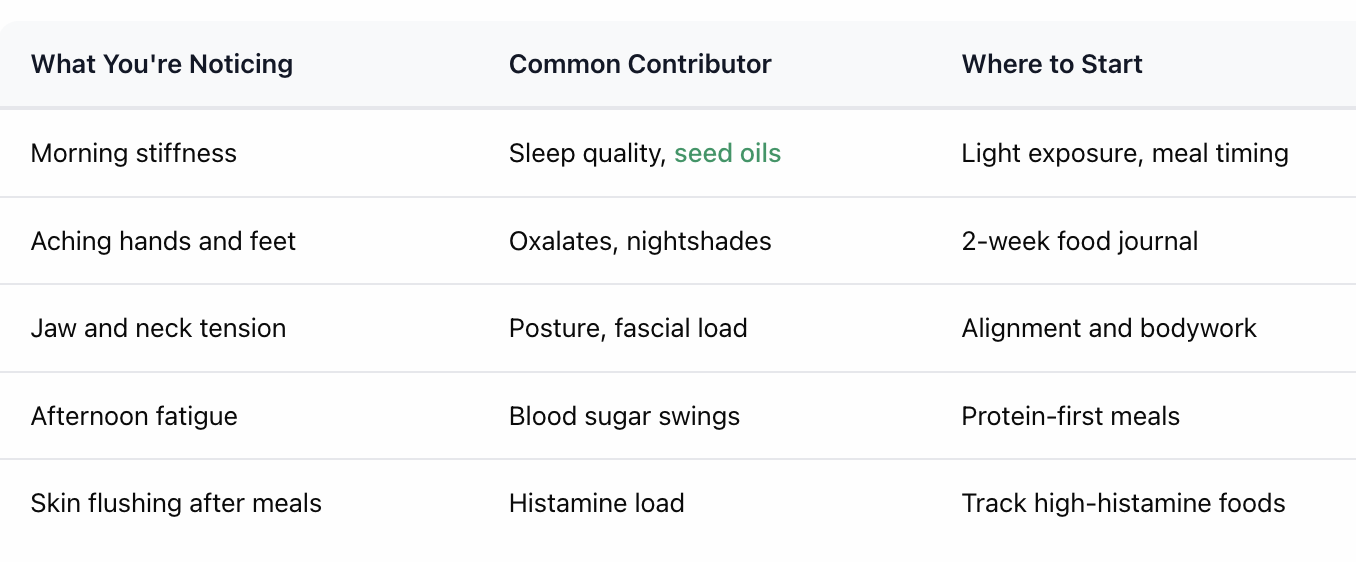
What most guides miss is that chronic inflammation rarely announces itself as inflammation. It shows up as morning stiffness, a puffy face, a sore jaw, headaches that follow certain meals, or a low-grade fatigue you have learned to work around.
The Anti-Inflammatory Diet: Beyond the Mediterranean Template

An anti-inflammatory diet is not a menu.
It is a way of eating that lowers the inputs your immune system reacts to, and the inputs that matter most are often invisible on a standard food list. The popular framing centers on fish, olive oil, and produce, which is a reasonable starting point.
Why Some 'Healthy' Foods May Not Be Working for You
Spinach, almonds, tomatoes, and beans sit on nearly every anti-inflammatory list. They are also high in oxalates, phytates, or histamines, compounds that a subset of people handle poorly.
This is why a food can be healthy in general and still be wrong for you specifically. If you have been eating a "clean" diet for two years and your knees still hurt, the diet itself may be part of the question rather than the answer.
The Frameworks People Actually Use to Investigate This
Several dietary frameworks exist specifically because the standard anti-inflammatory template does not work for everyone. Paleo removes grains, legumes, and most processed foods, which eliminates many lectin and phytate sources in one move.
The honest position is that none of these frameworks is universally right. They are tools for generating information about your own body. A two-week trial of removing one category, followed by a deliberate reintroduction, could tell you something but not always. Sometimes you need to remove multiple categories to see results.
I began playing with food choices back in 2014. I’ve been my own experiment and I can confirm things often touted as healthy are likely having a negative impact on most people. This is one of the ways I help you as a coach. There are categories of foods that are often associated with the same health issue.
Key Takeaway: A food that is anti-inflammatory on average can still be pro-inflammatory for you. The only way to know which category you fall into is to test it and track what changes.
Ingredients, Not Labels

Reading the ingredient list matters more than reading the front of the package.
"Low-fat" and "heart-healthy" labels appear on products loaded with refined seed oils, added sugar, glyphosate, and emulsifiers like polysorbate 80 and carboxymethylcellulose, which research suggests may affect the gut microbiome.
A bag of trail mix with soybean oil and cane syrup is not the same input as a handful of raw nuts, even though both carry the same marketing language. This is where looking closely at ingredients, rather than counting anything, changes what you actually eat.
The Problem With Food Sensitivity Testing
People tell me they’ve had food sensitivity testing done and they adopted a diet based on those results. Here’s the problem: food sensitivity testing can only tell what you’ve eaten the last 6 months. It’s not a surefire, 100% accurate, way to determine which foods do and don’t work for you.
The most accurate way to determine what isn’t working is an elimination diet. Not just one or two foods, you need to remove all the foods that behave in the same way.
Ex: Many believe gluten free is sufficient but they still struggle, they just struggle slightly less than they did before. There’s no such thing as gluten free. Gluten is a lectin. Lectins are found in all grains, beans, nuts, seeds, and even some vegetables.
Foods That Cause Inflammation: Common Triggers to Investigate
Foods that cause inflammation are not universal, but several categories are worth examining first because they show up repeatedly in the research. Refined seed oils high in linoleic acid, soybean, canola, corn, sunflower, safflower, oxidize easily during processing and again inside the body, and their breakdown products feed into inflammatory signaling pathways.
Added sugar drives glycation, the process where sugar binds to proteins and forms advanced glycation end products (AGEs). Collagen in tendons, fascia, and skin is especially vulnerable because it turns over slowly, which means glycation damage accumulates.
Refined seed oils: soybean, canola, corn, sunflower, safflower
Added sugar and refined flour
Alcohol, particularly in the evening
Ultra-processed foods with emulsifiers and additives
High-oxalate foods if you are a responder
High-histamine foods
Nightshades if joint pain worsens after meals
Watch Out: Removing one trigger food for three days and declaring it "fine" tells you almost nothing. Reactions are often delayed by 24 to 72 hours, which is why food-symptom journals beat elimination guesswork. Track what you ate, when you ate it, and how you felt for at least two weeks before drawing conclusions.
When a Food Reaction Is Not the Whole Story
Most guides stop at the food list. The harder question is when to stop investigating on your own and involve a clinician. Persistent joint swelling, pain that wakes you from sleep, unexplained weight loss, fever, or symptoms that are getting worse rather than better over weeks are not food-sensitivity patterns, they are signals that deserve medical evaluation. Chronic inflammation that lingers for months without an obvious trigger can also be a feature of autoimmune conditions, and those are worth ruling in or out with a doctor rather than through diet experiments alone.
Your body’s default program is to heal itself. All you have to do is give it what it needs.
How to Tell If Anything Is Working
Measuring progress is where most natural-inflammation advice falls apart. Standard blood markers like C-reactive protein (CRP) and erythrocyte sedimentation rate (ESR) can be useful, but they are blunt instruments, they can be normal while you still feel terrible, and they can be elevated for reasons that have nothing to do with your diet.
Symptom tracking is often more useful than a lab value. Track morning stiffness duration, pain location and intensity, energy at 2 p.m., sleep quality, and digestive symptoms on a simple 1-to-5 scale.
Pro Tip: If you are going to spend money on testing, ask what decision the result will change. A marker that does not alter what you do next is information without a use.
The Overlooked Link Between Sleep and Inflammation
Sleep and inflammation run in both directions: poor sleep raises inflammatory markers, and inflammation disrupts sleep. This is the loop that traps so many people.
Circadian biology is the mechanism here. Your immune system has a daily rhythm, and light exposure, meal timing, and temperature all set it.
The Sleep Foundation's research on sleep and inflammation notes that chronic sleep loss is associated with elevated inflammatory markers. If your sleep has been broken for months, treat it as a primary issue, not a side effect.
When Inflammation and Joint Pain Keep You Stuck
Inflammation and joint pain reinforce each other through the fascia, the connective tissue web that wraps every muscle, nerve, and organ. When fascia loses glide from dehydration, disuse, or chronic tension, the tissue around a joint becomes the problem, not the joint itself.
A common mistake is chasing the sore spot with pressure or stretching and never asking why that spot is overloaded. A jaw that aches may be responding to a neck that has lost rotation. A hip that pinches may be compensating for a foot that stopped pronating years ago.
Pro Tip: Track pain by time of day, not just location. Morning stiffness that eases within 30 minutes of movement points in a different direction than pain that builds through the day. That pattern is useful information for any practitioner you work with.
How to Manage Inflammation Naturally With Movement and Bodywork
Movement, light, sleep, and hands-on work can all influence inflammation, but they work best as a coordinated approach rather than isolated fixes. Yoga and slow mobility work address the nervous system side. Stress reduction is not a soft recommendation; cortisol directly influences inflammatory pathways.
This is where individualized bodywork fits. I use slow, purposeful strokes waiting for your body to respond instead of forcing my way in.
Primal Lifestyle Testimonials offers a useful overview of primal diets and their effects of various health conditions.
Conclusion: Your Experience Is Worth Investigating
The honest answer to how to manage inflammation naturally is that there is no single protocol, and anyone selling you one is guessing about your body. What works is paying attention, changing one variable at a time, and learning from your own response. Information is useful. Knowing what to do with it is different.
If you have been told your stiffness, aches, or fatigue are simply part of getting older, that explanation is worth questioning. Better questions can lead to better understanding, and your experience is worth investigating.
If you are ready to stop guessing and start investigating, I offer individualized bodywork and Primal Health Coaching that look at the whole person rather than only the spot that hurts.
Schedule a massage appointment or explore The Other 23 to see what happens in the hours outside the treatment room.
Frequently Asked Questions
What are the most common signs of inflammation in the body?
Signs of chronic inflammation can be subtle and are often dismissed as normal aging. They may include persistent joint stiffness or pain, frequent headaches, ongoing fatigue, digestive issues like bloating or irregularity, poor sleep, and changes in body composition. Unlike acute inflammation, which causes obvious redness and swelling, systemic inflammation operates quietly. If you experience several of these symptoms together, it's a signal worth investigating with a healthcare professional to understand what might be contributing.
What are the 5 worst foods for inflammation?
While individual responses vary, several categories are common culprits. These include refined seed oils high in linoleic acid, added sugars and refined carbohydrates, highly processed foods with artificial ingredients, excessive alcohol, and for some people, specific proteins or plant compounds like lectins and nightshades. The key is that 'worst' is personal. An anti-inflammatory diet is an investigation to see how your unique body responds when you reduce these potential triggers and focus on whole, nutrient-dense foods.
Can poor sleep affect inflammation and pain?
Yes, the connection between sleep and inflammation is significant. During deep sleep, your body repairs tissues and regulates inflammatory pathways. Chronic sleep disruption can increase systemic inflammation and lower your pain tolerance, making existing aches feel worse. This creates a cycle where pain disrupts sleep, and poor sleep amplifies pain. Investigating sleep quality is a fundamental step in managing inflammation naturally.
How long does it take to notice changes when investigating inflammation triggers?
The timeline is different for everyone and depends on the changes you make and your body's unique response. Some people notice improvements in digestion or energy within a week or two of changing their diet. For others, changes in chronic joint pain or stiffness may take a month or more. It's helpful to track your symptoms and energy levels to see patterns. Patience and consistency are more important than speed when you are trying to manage inflammation naturally.
When should persistent inflammation symptoms be discussed with a healthcare professional?
You should consult a healthcare professional for any new, severe, or persistent symptoms. If you have joint pain that is red, hot, or swollen, or if you experience unexplained fatigue, fever, or weight loss, seek medical evaluation. A diagnosis is essential to rule out conditions that require medical treatment. Think of your investigation into natural management as a complement to, not a replacement for, professional medical care.
How can movement help with inflammation and stiffness?
Movement helps manage inflammation by improving circulation, which delivers nutrients and removes metabolic waste. It also supports the lymphatic system and can help regulate blood sugar. For stiffness, gentle movement like walking, swimming, or yoga can increase synovial fluid in the joints and improve tissue elasticity. The goal is consistent, moderate physical activity, not intense exercise that can sometimes increase inflammation if you're already stressed or run down.
Get My Free Guide Below To Begin Tracking Your Habits
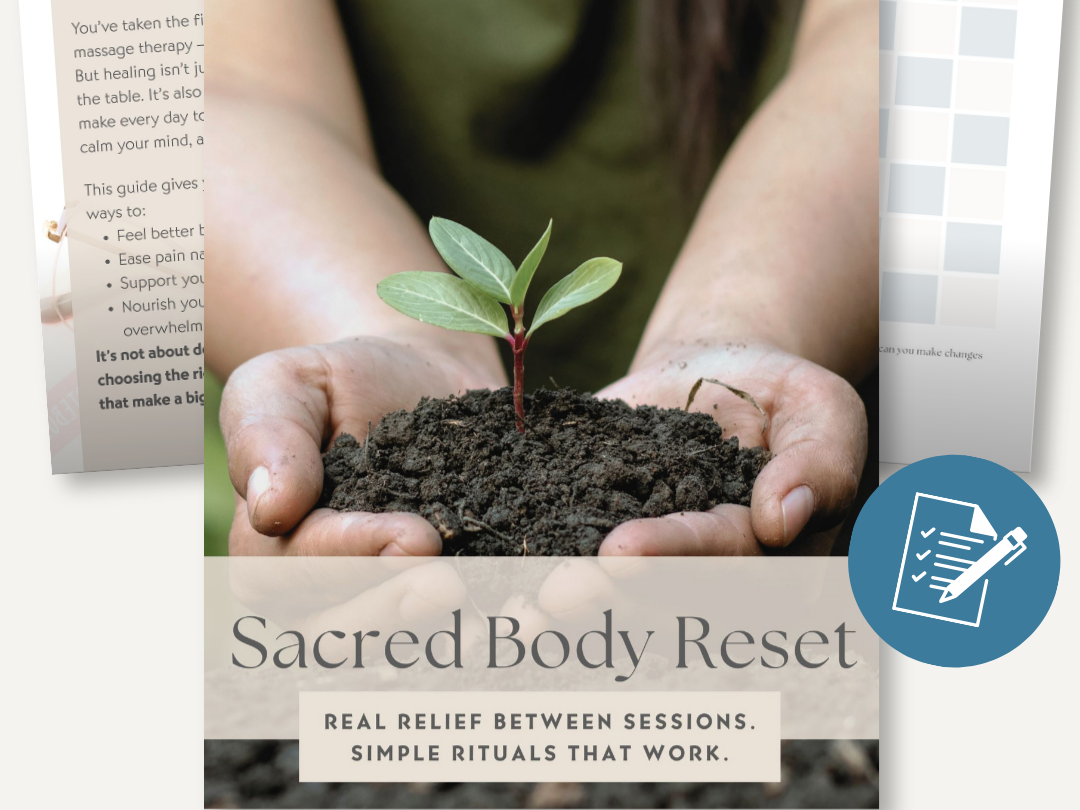
You’ve taken the first step by receiving massage therapy — and that’s powerful. But healing isn’t just what happens on the table. It’s also the tiny choices you make every day to support your body, calm your mind, and stay in flow.
This guide gives you simple, effective ways to:
Feel better between visits
Ease pain naturally
Support your nervous system
Nourish your body without overwhelm
It’s not about doing more — it’s about choosing the right things. Little shifts that make a big difference.
