

Advanced Glycation End Products and Tissue Stiffness

Table of Contents
What Advanced Glycation End Products Are and How They Form
AGEs and Collagen: How Cross-Links Change Tissue Stiffness
Dietary Advanced Glycation End Products vs. AGEs Made Inside Your Body
Causes of Joint Stiffness: Where Glycation Fits In
Tissue-by-Tissue: Skin, Arteries, Muscles, and Cartilage
How AGE Burden and Tissue Stiffness Are Measured
What May Reduce AGE-Related Stiffness (and What the Evidence Actually Shows)
Conclusion: Maybe It's Not Your Age
Frequently Asked Questions
What Advanced Glycation End Products Are and How They Form
Advanced glycation end products and tissue stiffness are connected by a process most people have never heard of, yet it may explain why your hands feel tight in the morning. Advanced glycation end products, or AGEs, form when sugar molecules attach to proteins without any help from enzymes. That process is called glycation, and it happens slowly and continuously inside your body.
Glycation needs no digestion or metabolism. Sugar simply bumps into protein and bonds with it.
The rate of this bonding depends heavily on blood glucose levels. When blood sugar runs high, glycation accelerates. According to research on glycation and aging from the National Institutes of Health, AGE accumulation is one of the better-studied biomarkers of biological aging. That matters because it means AGEs are not just an abstract lab concept. They are measurable, and they build up in the tissues you use every day.
Most people assume the char on a grilled steak is the main AGE source. It contributes, but the bigger driver is the sheer volume of sugar and refined carbohydrates in the modern diet.
AGEs and Collagen: How Cross-Links Change Tissue Stiffness
Collagen is the most abundant protein in your body, and one of the longest-lived. That longevity is why glycation matters so much. Once sugar attaches to collagen, it can form permanent non-enzymatic cross-links between protein fibers, changing the tissue's mechanical properties.

Think of healthy collagen as a rope that can slide and recoil.
Cross-linked collagen is more like a rope with knots tied every few inches. It still holds, but it cannot stretch the way it should.
The same cross-linking happens in elastin, the protein that lets your skin and blood vessels snap back. Elastin has very little turnover, so damage accumulates for decades. AGEs and collagen research keeps pointing to the same conclusion: tissue stiffness is not only about wear and tear. It is also about chemistry.
This is where the "maybe it's not your age" question becomes worth asking. Chronological age matters, but AGE burden is something you can influence.
Dietary Advanced Glycation End Products vs. AGEs Made Inside Your Body
Dietary advanced glycation end products come from food, while endogenous AGEs form inside your body. Both matter, but they behave differently, and mixing them up leads to confusion.
Dietary AGEs form during cooking, especially with dry heat and sugar. Endogenous AGEs form when your own blood glucose reacts with your own proteins. The second type is more closely tied to metabolic health.
This is why a person with well-controlled blood sugar may accumulate fewer AGEs than someone eating the same foods with poor glucose control. It also explains why conventional dietary advice focused only on fat and calories misses the point.
If you want to get curious about your own diet, look at ingredients rather than numbers. How much sugar and refined carbohydrate is actually on your plate? That question tends to be more useful than counting anything.
Causes of Joint Stiffness: Where Glycation Fits In
Common causes of joint stiffness include injury, inactivity, inflammation, and osteoarthritis. Glycation is another contributor that rarely gets mentioned in a standard appointment. When AGE cross-links build up in cartilage and connective tissue, the tissue loses some of its ability to deform and recover.
Cartilage has no blood supply, so it repairs slowly, and cross-links there are especially stubborn. The same is true for fascia, the web of connective tissue that wraps every muscle. Stiff fascia changes how you move, and altered movement patterns can create pain somewhere else entirely.
The place that hurts is not always the place that needs attention. A stiff ankle can change your gait, which can load your low back. A tight hip can pull on your neck. Bodywork helps here because it addresses the whole pattern, not just the spot that aches.
Tissue-by-Tissue: Skin, Arteries, Muscles, and Cartilage
AGEs do not affect every tissue equally. What determines the damage is not how much blood flows through a tissue but how slowly its proteins turn over.
Skin is the tissue most people notice first. Dermal collagen and elastin are long-lived, and cross-links there reduce the skin's ability to recoil. Researchers often use skin autofluorescence as a proxy for whole-body AGE burden because skin collagen reflects decades of accumulation rather than the last few weeks of eating.
Arteries are where the stakes are highest. The arterial wall is rich in elastin, and elastin has almost no turnover after early adulthood. Cross-links there stiffen the vessel, raising pulse pressure and forcing the heart to work against a less compliant system.
Skeletal muscle is more nuanced than most summaries suggest. The cross-linking happens primarily in the extracellular matrix surrounding the muscle fibers, not inside the contractile proteins themselves.
Cartilage may be the most stubborn tissue of all. Articular cartilage has no blood supply, so it depends on joint movement to circulate synovial fluid and deliver what little nutrition it receives.
Fascia deserves its own mention because it is often left out of these discussions entirely. The fascial web is continuous, wrapping muscle, bone, nerve, and organ, and its collagen is subject to the same glycation chemistry as everything else. When fascial tissue stiffens, it changes how force travels through the body.
This tissue-by-tissue picture explains apparent inconsistencies in the research. Studies on vascular stiffness, skin autofluorescence, and muscle function measure different tissues with different turnover rates and mechanical roles, so a finding in one does not automatically translate to another.
Key TakeawayTissue turnover rate, not blood flow, predicts where AGE cross-links accumulate most. Skin, arteries, and cartilage are slow-turnover tissues and show the earliest functional changes. Muscle and fascia sit in between. This is why the same chemistry produces different symptoms in different people.
How AGE Burden and Tissue Stiffness Are Measured
Measuring AGE burden in a living person is harder than it sounds. The research literature uses several methods, and each answers a different question. Confusing them is one of the most common ways people misread their own situation.
Skin autofluorescence is the closest thing to a non-invasive AGE burden measure. Certain AGE compounds fluoresce under specific wavelengths of light, and a device placed against the forearm can estimate how much has accumulated in dermal collagen (pubmed.ncbi.nlm.nih.gov). It is used widely in diabetes and aging research because it correlates with vascular and renal outcomes.
Blood tests for specific AGE compounds, such as carboxymethyllysine or pentosidine, measure what is circulating right now. That is useful for research on dietary exposure and short-term metabolic state, but it does not tell you how much has already cross-linked into your tissues.
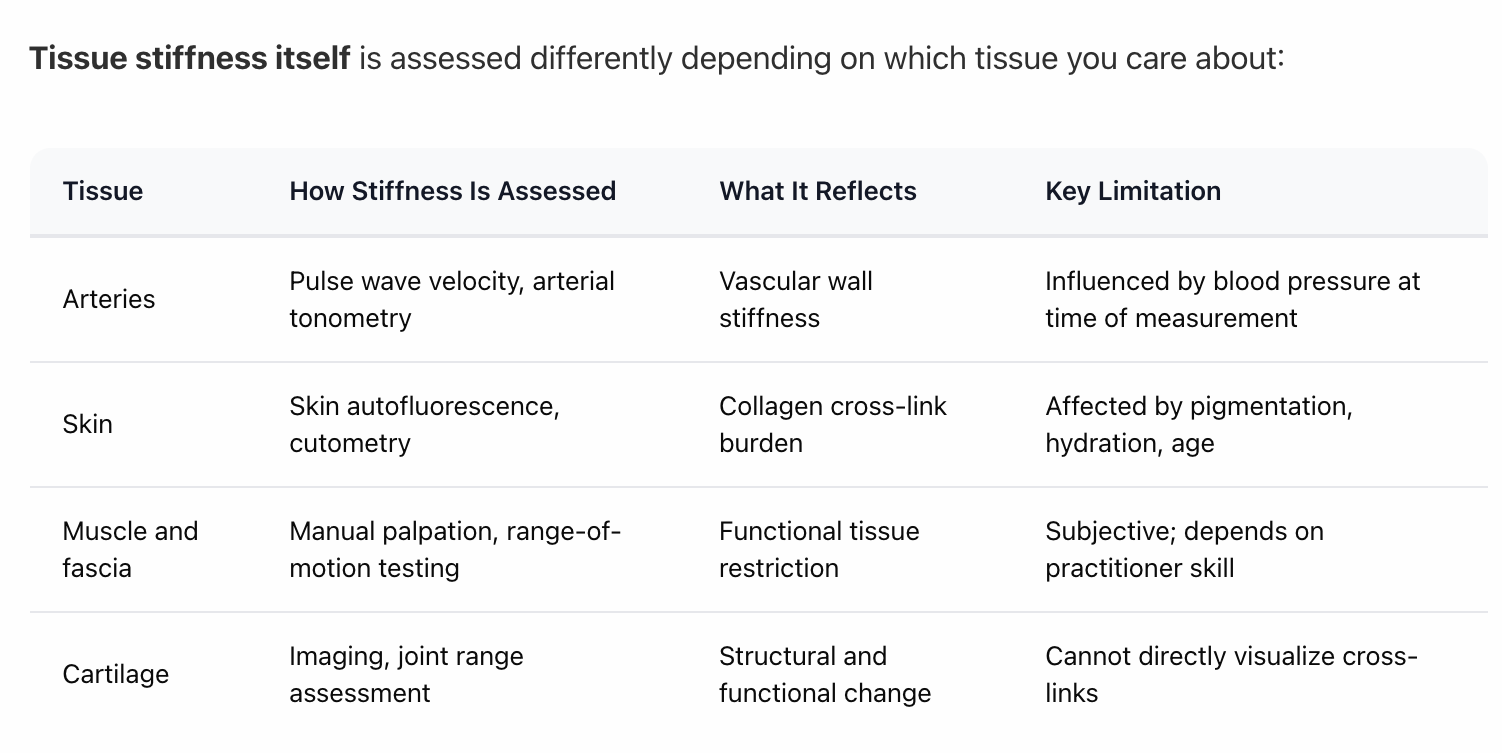
What most guides miss is that no single test tells the whole story. Research on tissue AGE and endogenous AGE formation uses different methods than dietary AGE studies, and comparing them directly can mislead you.
There is also the question of what you are actually trying to learn. If you want to know whether your diet is contributing to glycation, tracking your own glucose response to meals may be more useful than a single AGE lab value.
This is where the conventional approach leaves a gap. A standard appointment rarely has time to connect a lab value to how you actually feel.
Watch Out: No single measurement captures AGE burden or tissue stiffness completely. Skin autofluorescence, blood AGE markers, pulse wave velocity, and hands-on assessment each answer a different question. Treating any one of them as a definitive answer is a common mistake.
If you want to investigate your own situation, start with what you can observe. How do your joints feel in the morning? How quickly do they loosen up? Does your range of motion change after a few days of different eating? These are not lab values, but they are data. Your body is giving you information, and sometimes the most useful measurement is the one you take yourself.
What May Reduce AGE-Related Stiffness (and What the Evidence Actually Shows)
Interventions that may affect AGE-related stiffness fall into a few categories, with widely varying evidence.
Blood sugar control: Strongest evidence. Lower average glucose means less new glycation.
Diet quality: Moderate evidence. Reducing sugar and refined carbohydrates lowers the raw material for glycation.
Movement and bodywork: Supportive evidence. Better circulation and tissue mobility help function even when cross-links already exist.
Fasting and autophagy: Emerging hypothesis. Autophagy helps clear damaged proteins, but its direct effect on existing cross-links is still being studied.
Heat and cooking methods: Practical. Moist cooking produces fewer dietary AGEs than dry, high-heat methods.
Watch Out: A common mistake is assuming that one intervention will reverse decades of accumulation. Existing cross-links are chemically stable, so the realistic goal is slowing new formation while improving how the tissue functions now.
Bodywork can improve mobility and reduce tension, but it works best alongside the choices you make during the other twenty-three hours of your day.
Conclusion: Maybe It's Not Your Age
Stiffness that shows up in your forties and fifties is often waved away as normal aging. Glycation research suggests the explanation is more interesting. AGEs form, cross-link collagen, and change how your tissues behave, and the rate depends partly on factors you can influence.

If you have been told your aches are just part of getting older, your experience is worth investigating.
I use slow, purposeful bodywork and a whole-person approach to help you understand what your body is communicating.
If you are ready to look closer, schedule a massage appointment with Jennifer or explore health coaching to investigate the patterns behind how you feel.
Frequently Asked Questions
What are advanced glycation end products?
Advanced glycation end products, or AGEs, are compounds that form when sugars bond to proteins without an enzyme directing the reaction. That bond, called glycation, creates irreversible cross-links between protein strands. Collagen and elastin, which give skin, tendons, and blood vessels their flexibility, are especially vulnerable because they turn over slowly. Over years, those cross-links accumulate and change how tissue bends, recoils, and transmits force. AGEs are one reason researchers study tissue stiffness as a marker of biological aging rather than a simple calendar effect.
How can advanced glycation end products affect tissue stiffness?
Cross-links act like extra rungs welded between protein strands that should slide past each other. In collagen-rich tissue, that means less give, less elastic recoil, and more resistance to stretch. Researchers measure this in arterial walls, skin, and connective tissue using tests like pulse wave velocity and skin autofluorescence. The stiffness is not only mechanical; AGEs also bind receptors that trigger oxidative stress and inflammation, which can further change the extracellular matrix. This helps explain why joints and muscles can feel tight even when imaging looks unremarkable.
Can AGEs contribute to stiff joints or connective tissue?
Yes, that is one of the better-supported connections in this area. Articular cartilage and connective tissue depend on a healthy collagen network, and AGE cross-linking alters its mechanical properties. Studies of aging cartilage show increased stiffness and reduced resilience that track with AGE accumulation. That said, joint stiffness is usually multifactorial. Movement patterns, hydration, sleep, prior injury, and inflammatory load all play a role. Glycation is worth investigating as one contributor, not the only explanation, which is why an individualized approach matters more than a single fix.
Does grilled or charred meat cause advanced glycation end products?
Cooking meat at high heat does create AGEs, and charred meat contains more of them. But the bigger driver of glycation in most modern diets is the abundance of sugar and refined carbohydrates, not grilled meat. Elevated blood glucose gives sugars more opportunity to bond with proteins inside the body, which is where most long-lived tissue AGEs form. If you are investigating stiffness, looking closely at overall carbohydrate load and food quality will likely tell you more than avoiding a backyard burger.
Your body is giving you information. Better questions can lead to better understanding, and sometimes the most useful thing you can do is stop accepting "it's just your age" as the final answer.
