

Table of Contents
Why Muscle Aches in Women Over 40 Aren't Just Aging
What Your Tissues Are Telling You Before the Pain Starts
The Muscle Mass and Blood Sugar Connection Nobody Explains
How Skeletal Muscle Clears Glucose From Your Bloodstream
Exercise and Blood Sugar Control: Why Movement Is Medicine for Muscle
Sleep and Muscle Recovery: The Repair Window You're Probably Skipping
What Chronic High Blood Sugar Does to Muscle and Connective Tissue
What to Ignore: Common Bad Advice About Aging and Aches
How Health Coaching Helps You Investigate Your Own Patterns
Schedule a Massage Appointment With Jennifer
Frequently Asked Questions
Why Muscle Aches in Women Over 40 Aren't Just Aging
You wake up stiff. Your shoulders ache before you've done anything. And someone, probably more than one person, has told you this is just what happens after 40. Resistance training is necessary for blood sugar control and the prevention of sarcopenia. As we age we naturally lose muscle mass and weak muscles become fibrotic. They’re working harder because there’s less of them.
Being told, “it’s just your age” is an incomplete explanation. I treat your complaints it as a starting point for investigation rather than a verdict. Health coaching for women over 40 with muscle aches works best when it asks a different question: what changed in your tissues, your sleep, your food, and your movement before the pain showed up?
The more likely scenario is your diet and lifestyle are out of alignment with your human biology. Why do I speak about animal protein and food choices so often? Because that’s the root of it all. Every cell needs nutrients, but it also needs the absence of irritants.
You’re not old. Maggie is a prime example of what’s possible for human health.
Are you on par to jump a fence at 82?
This Is Maggie - The 85 Year Old Carnivore
What Your Tissues Are Telling You Before the Pain Starts
After more than two decades of hands-on work, I can tell you that tissue feels different before it hurts. Restricted tissue can feel dense and guarded under the hand, and underused muscle can feel slack.
Changes in tissue texture can be clues worth investigating. The ache is often not the first signal the body sends.
The Muscle Mass and Blood Sugar Connection Nobody Explains
Skeletal muscle is your largest glucose storage site. It is one of the body's main sites for clearing glucose after a meal. When muscle mass drops, that clearing capacity can decline, and blood sugar control can become harder.
Here is the part that rarely makes it into a wellness article. Muscle is not just a storage tank. It is metabolically active tissue that signals to the rest of your body. When muscle contracts, it releases proteins called myokines that influence inflammation, insulin sensitivity, and even how your brain handles stress. A shrinking, underused muscle is quieter than it should be, and the whole system notices.
Muscle loss can accelerate through perimenopause and menopause for many women. Estrogen plays a role in muscle protein synthesis and in how efficiently muscle uses glucose. When estrogen declines, the same diet and activity level that worked at 35 can produce a very different body composition at 48. Less lean mass means less glucose uptake, more circulating blood sugar, and more of the low-grade inflammation that makes tissue feel achy and stiff.
This is where the conventional advice goes sideways. Women in this stage are often encouraged to eat less and do more cardio to manage weight. Cardio alone does not build the lean mass that helps clear glucose, and eating less without enough protein can accelerate the muscle loss that makes blood sugar harder to control.
Even more infuriating, I’m seeing women in their 50’s, 60’s, and beyond who are becoming frail due to GLP1 usage. I’ve yet to meet one who’s taking in adequate protein and lifting heavy weights. They’re excited about the number on the scale not realizing they’re giving up longevity for that number.
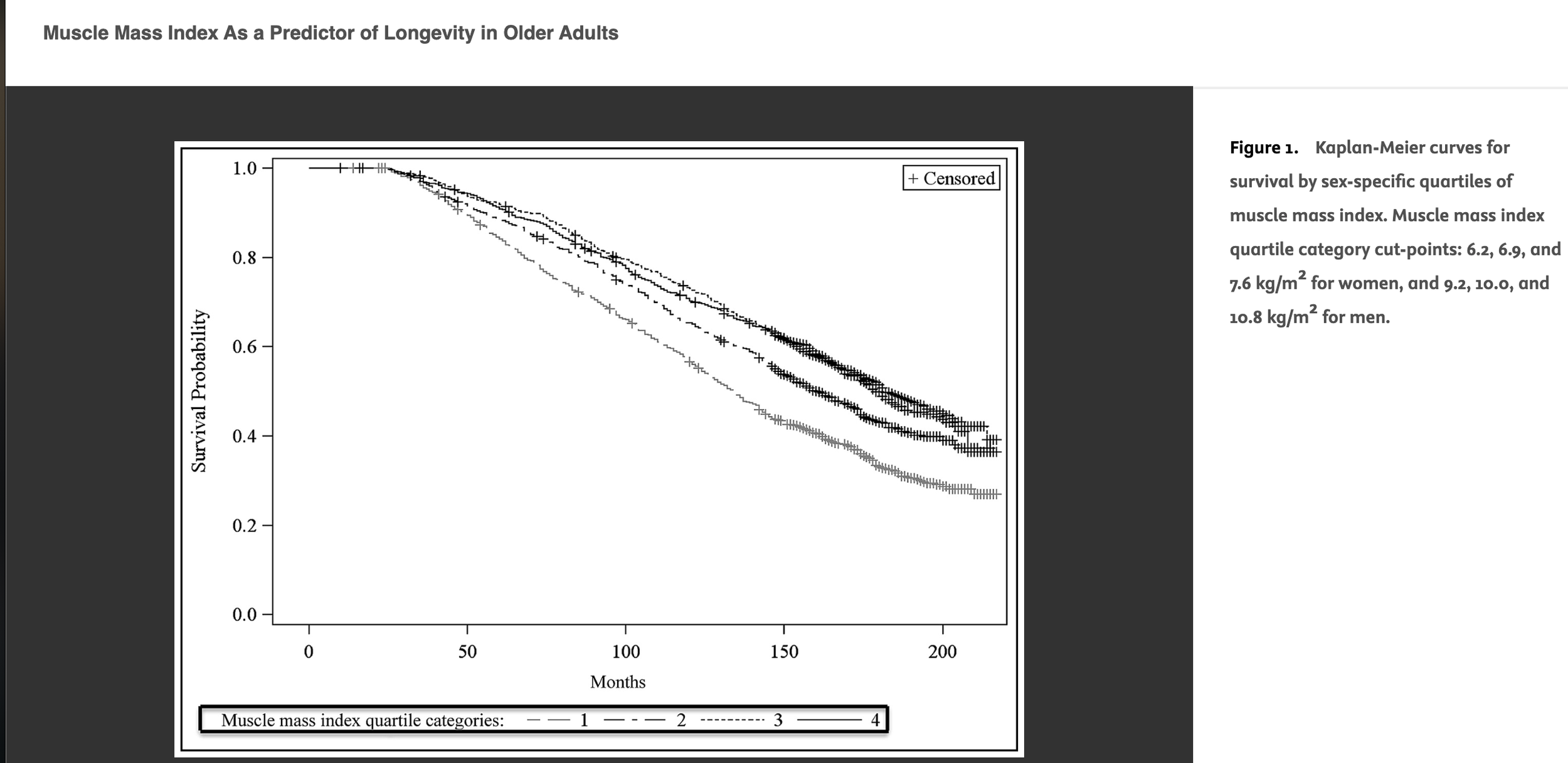
Muscle mass as a predictor of longevity: https://www.amjmed.com/article/s0002-9343%2814%2900138-7/fulltext
How Skeletal Muscle Clears Glucose From Your Bloodstream
Muscle takes up glucose in two ways. Insulin signals cells to move glucose transporters to the surface, opening the door. Muscle contraction opens a separate door that does not require much insulin at all. That second pathway is why physical activity matters so much. A working muscle clears post-meal blood sugar without needing much insulin. A resting, shrinking muscle does neither job well.
Over time, when muscle is not asked to contract and blood sugar stays elevated, the insulin door becomes less responsive. That is insulin resistance in plain English: the signal is there, but the tissue has stopped listening. The research on this is deep and consistent, and it explains why so many women over 40 are told their fasting glucose is "a little high" years before anyone mentions muscle.
What most guides miss is that this is not a one-way street. Muscle can regain insulin sensitivity with the right inputs, and the inputs are not exotic. Adequate animal protein, resistance training, sleep, and time away from constant snacking all give muscle a reason to stay metabolically awake. The question worth sitting with is not whether you need to eat less, but whether your muscle has been given a reason to hold onto glucose at all.
Exercise and Blood Sugar Control: Why Movement Is Medicine for Muscle
Movement is the most reliable lever you have for glucose regulation, and it works through the contraction pathway described above. Muscle contraction drives glucose uptake, and resistance training builds the lean mass that keeps that capacity in place. The American Diabetes Society recommends breaking up sitting time and including strength training most weeks, which is about as close to a consensus as this field gets.
But here is where the standard advice stops being useful. "Exercise more" is not a strategy. For a woman over 40 with aching shoulders and a body that has not lifted anything heavy in years, the question is not whether to move but where to start and how to progress without setting off a flare. That progression looks different depending on your starting point, and most articles skip that part entirely.
Walking after dinner is not a throwaway habit. It is glucose clearance in its simplest form, and it works because the muscle contraction pathway does not care whether you are in a gym. Short walks after meals are commonly associated with a blunted post-meal glucose response. The ancestral lens here is obvious once you see it: humans did not evolve to sit for hours and then exercise in a single block. They moved in frequent, low-intensity patterns throughout the day, and that pattern happens to be well suited to how muscle handles glucose.
Start where you actually are:
The deeper point is that exercise is not a calorie-burning transaction. It is a signal to your muscle that it is still needed. That signal influences insulin sensitivity, inflammation, and the texture of your connective tissue. If you have been told to "just walk more" and it has not changed how you feel, the missing piece may not be more walking. It may be the kind of movement that tells your muscle to stay metabolically awake, and that is a conversation worth having with someone who can look at your whole pattern rather than hand you a step count.
Sleep and Muscle Recovery: The Repair Window You're Probably Skipping
Deep sleep is an important period for tissue repair and recovery.
Screen exposure at night pushes melatonin later and fragments sleep. That is a modern mismatch, not a personal failing. If you want to understand the sleep-inflammation link in more depth, read how sleep affects inflammation and joint pain.
Morning daylight, dimmer evenings, and a consistent bedtime are commonly discussed as supportive of sleep.
What Chronic High Blood Sugar Does to Muscle and Connective Tissue
Persistently high blood sugar can contribute to glycation, a process in which sugar binds to proteins and may affect how connective tissue behaves.
The result shows up as reduced mobility, slower repair, and tissue that feels thick under the hand. If you suspect sugar is part of your joint pain picture, could sugar be making your joint pain worse explores that connection.
What to Ignore: Common Bad Advice About Aging and Aches
Common advice about muscle aches often focuses on a single intervention. Addressing hydration, sleep, and blood sugar alongside movement is one way to look at the bigger picture.
A common mistake is treating the sore spot as the only problem. The place that hurts is not always the place that needs attention.
How Health Coaching Helps You Investigate Your Own Patterns
Health coaching for women over 40 with muscle aches is not a meal plan and a pep talk. It is a structured way to connect your symptoms to your daily habits and learn from your own responses.
After earning my BS in Environmental Science I worked as an analytical chemist for 5 years. Seeing those same chemicals in the grocery store in my 20’s I became an avid reader of ingredients. Deciding my work with hazardous chemicals wasn’t a plan for longevity I became a massage therapist in 2002.

What You’ll Get From Me:
20+ years of bodywork experience
Certified Primal Health Coach 10+ years
Functional Lab Testing Specialist
More than a decade of studying nutrition and lifestyle
A very specific philosophy
Actual client outcomes
Experience working with women 40+
A framework that considers food + movement + sleep + stress + sunlight + recovery + lifestyle
The ability to explain why rather than simply handing people rules
Real-world experience seeing what happens when people implement these changes
And most importantly:
I've lived the experiment myself. My perspective isn't theoretical.
I offer hands-on bodywork alongside health coaching. Consider me an educator and guide. Using ancestral health principles, I help you look at patterns between what you eat, how you sleep, and how your tissues feel.
You can explore what health coaching involves, or look into The Other 23 Field Study, a 16-week small-group program for women 40 and older.
What coaching and massage look at and why it matters:
Food
Protein intake and time away from constant snacking
Gives muscle a reason to hold onto glucose
Sleep
Deep sleep as the tissue repair window
Supports recovery and connective tissue
Movement
Resistance training and short walks after meals
Drives glucose uptake through contraction
Tissue
Density and guarding felt under the hand
Clues appear before the ache does
Symptoms
The sore spot versus the whole pattern
The place that hurts is not always the problem
Schedule a Massage Appointment With Jennifer
Your body is giving you information. The question is whether anyone is reading it carefully.
If you are tired of being told your aches are just aging, let's investigate together. Your first coaching session is free and/or schedule an appointment to begin mapping your own path back to comfortable movement.
Muscle aches after 40 deserve a real investigation, not a shrug. Book with Jennifer Essary Medical Massage and bring your questions, your history, and your curiosity.
Frequently Asked Questions
Why do my muscles ache more after 40?
Muscle aches after 40 rarely come from one cause. Muscle mass declines gradually when protein intake and resistance training are low, which reduces glucose uptake and leaves more circulating blood sugar. Poor sleep, chronic stress, dehydration, and fascial restriction all change how tissue feels and functions. Perimenopause adds hormonal shifts that affect recovery. The ache is often a signal that several inputs need attention, not proof that aging is the whole story.
How does muscle mass relate to blood sugar control?
Skeletal muscle is the largest glucose storage site in the body. After a meal, muscle takes up glucose from the bloodstream, and greater muscle mass means more capacity for that clearance. When muscle is lost through inactivity or under-eating protein, the body has fewer places to put post-meal glucose. That is why muscle mass and blood sugar are so tightly linked, and why resistance training and adequate animal protein matter for women over 40.
Can poor sleep and stress contribute to muscle tension?
Yes. Sleep and muscle recovery are directly connected because deep sleep is when tissue repair and hormone regulation happen. Short or fragmented sleep raises stress hormones, which keeps muscles guarded and increases pain sensitivity. Many women notice tighter shoulders, jaw tension, and low back stiffness after a stretch of bad sleep. Fixing sleep is often more useful than stretching harder.
How can health coaching for women with persistent muscle aches help?
Coaching helps you connect the dots between what you eat, how you sleep, how you move, and how your tissues feel. Rather than handing you a generic plan, a coach helps you track patterns, ask better questions, and test changes one at a time. For women over 40 with muscle aches, that investigative approach often reveals contributors that a single massage or a single supplement never addresses.

A 12-week health coaching and therapeutic bodywork experience for women 40+ who are ready to stop guessing and start paying attention.
Maybe it's not your age.
You're eating pretty well. You're exercising. You've tried the diets, supplements, workouts and wellness advice.
So why are you still stiff, tired, uncomfortable, gaining weight, sleeping poorly or wondering why your body doesn't feel the way it used to?
The Other 23: Field Study takes a different approach.
Instead of giving you another rigid diet or exercise plan, we'll investigate the things happening during the other 23 hours of your day—the hours outside the massage room.
Together, we'll explore:
Nutrition and food choices
Movement and daily activity
Sleep and recovery
Stress and lifestyle
Hydration and minerals
Sunlight and time outdoors
Habits and environment
Patterns in how your body feels and responds
Therapeutic bodywork and what your body may be telling you
This is not about perfection.
It's not calorie counting.
It's not a meal plan.
It's not another 30-day challenge.
It's a guided experiment.
You'll learn how to pay attention to your own experience, test practical changes, gather useful information and make better decisions about your health.
What's included
12 weeks of guided health coaching
Six individualized therapeutic 90 minute bodywork sessions
Bi-weekly small-group coaching (60 minutes)
The Other 23 Field Guide
Healthy Habits Library
Fitness Industry Reality Check
Practical health and lifestyle experiments
Defined between-session support
A small cohort limited to 20 women
The program begins in October and continues through January—because real health doesn't happen in a laboratory.
We'll navigate Thanksgiving.
We'll navigate the holidays.
We'll navigate travel, busy schedules, stress, imperfect meals and real life.
And when January arrives, you won't be starting over.
You'll have three months of information about yourself.
You'll know more about what helps.
What doesn't.
What surprises you.
What you can actually sustain.
And what deserves your attention.
Who is this for?
The Other 23 is designed for women 40+ who:
Feel like their body has changed and aren't sure why
Are doing “healthy” things but don't feel as healthy as they should
Are tired of conflicting health and nutrition advice
Have tried diets, exercise programs, supplements or wellness plans
Want to understand their body rather than simply follow another set of rules
Are curious, independent and willing to experiment
Want to feel capable and confident rather than increasingly limited by their age
20 women. One cohort. October → January.
