

Hydration Requires More Than Drinking A Lot Of Water Everyday
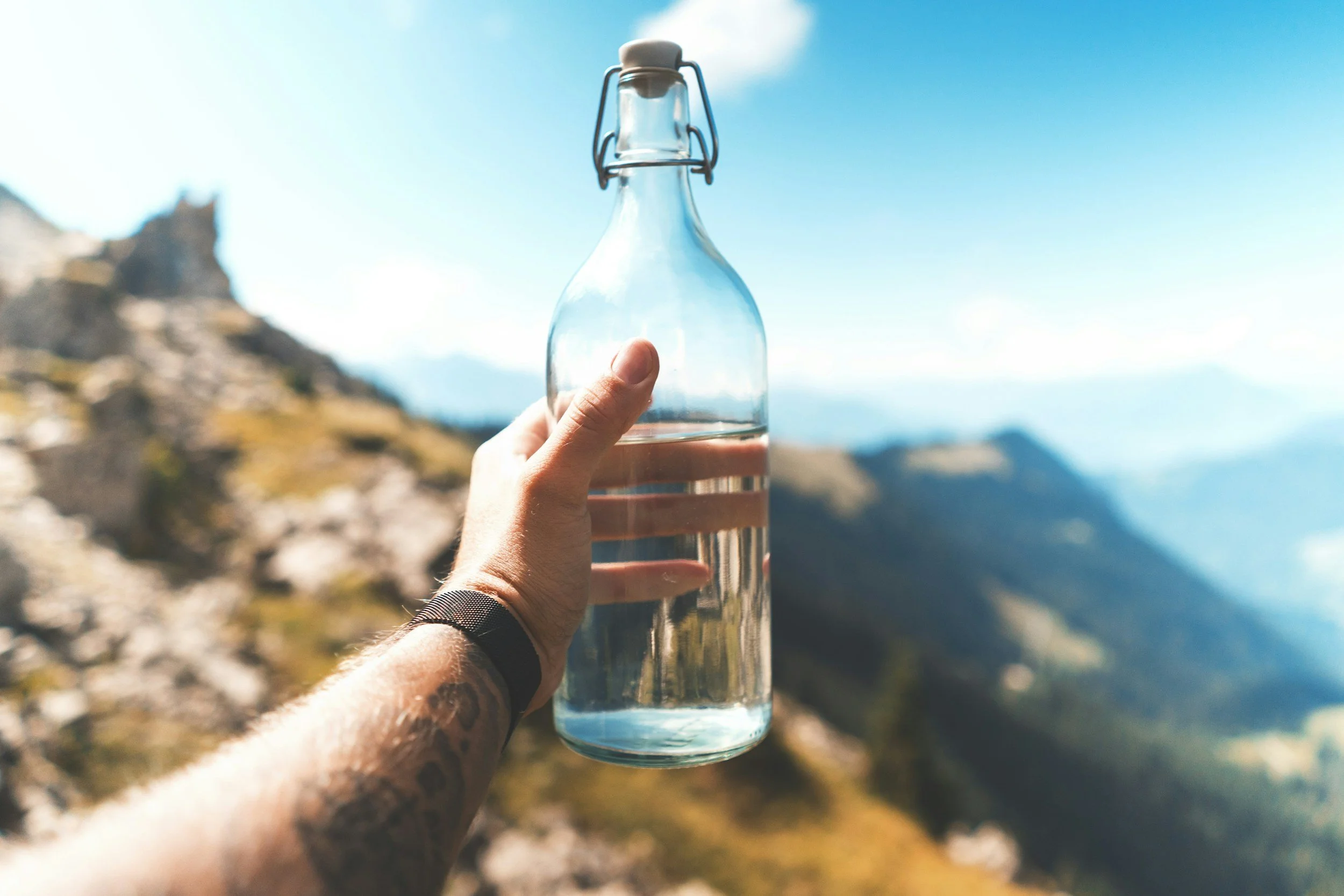
We’re the only species that forces ourselves to drink water beyond our natural thirst. Why?
This post contains affiliate links. I’ll earn a small commission at no extra cost to you. These commissions help financially support my work.
I see this everyday and I hear some healthcare professionals advise their patients to “drink a lot of water.” What does that even mean? Does it help?
People are carrying around oversized water jugs forcing themselves to drink the entire thing as if this is some over the top healthy habit. Yes, we need to drink water but just like most things, if something is good it doesn’t automatically mean more is better.
We’re the only species that forces ourselves to drink water beyond our natural thirst. Why? Someone somewhere, likely with a white coat, said they should drink a lot of water and it stuck and no one has questioned it since? There are so many things people believe to be true simply because they’ve been repeated many times.
Did you know the recommendation to drink 8 glasses occurred in 1945 — the same year they added fluoride to the water supply.
Looking at hydration from a health and hunter gatherer perspective no we don’t need to drink gallons of water a day. In fact, drinking gobs of the modern version of water might be doing more harm than good. It is possible to drink to much water and die.
Once upon a time all water was unfiltered. This meant it contained trace minerals and whatever was living in the water. Do you know Matt Graham? He’s been on a number of survival type TV shows. I first learned of him watching Dual Survival. Anyway, he’s an expert in bushcraft and he lives in the Utah desert living off the land. He can expertly build a shelter, find food, and the reason I’m bringing him up - he drinks wild water.
I’ve often wondered about his microbiome and I suspect it’s likely more diverse and full of populations most of us are missing because he lives in such close contact with nature. Even then, I don’t see him out forcing himself to drink beyond his natural thirst.
What Is Hydration?
Hydration is a balance of water and electrolytes.
Minerals such as sodium, potassium, and magnesium are key players when it comes to proper hydration.
I feel this regularly as a massage therapist. Someone will come in for a massage with overly rigid muscles. I’ll ask if they drink a lot of water and they’ll brag about how much water they drink in a day.
The minerals I mentioned above are water soluble. When we forcibly drink too much water we deplete our muscles of these minerals. Most people eating the Standard American Diet are already magnesium deficient and loading up on water further compounds the problem. Magnesium and potassium help relax the muscles among many other things. Your arteries, your intestines, your heart, they all have muscles.
Kidneys, Hydration, and Low Carb Eating
For years we’ve heard that salt is bad especially if you have high blood pressure. Again, if you say it often enough people will believe it. The problem isn’t the salt — it’s the sugar. And studies have shown that limiting salt increases a person’s chances of becoming diabetic, which plays a larger role in heart disease than salt ever did.
Sodium restriction and insulin resistance: A review of 23 clinical trials
James J. DiNicolantonio, James H. O’Keefe
Received: 20 Sept. 2022; Accepted: 06 Feb. 2023; Published: 14 Mar. 2023
https://doi.org/10.4102/jir.v6i1.78
Abstract
Background: Many clinicians recommend low-salt diets for lowering blood pressure but there may be unintended consequences such as worsening insulin resistance.
Aim: This paper aimed to find human clinical studies looking at low-salt diets on markers of glucose and insulin.
Methods: We reviewed PubMed using the search terms ‘sodium’, ‘insulin’ and ‘insulin resistance’ and found 23 human clinical studies testing low-salt diets showing negative harms on insulin or glucose.
Results: Twenty-three human clinical trials have shown that low-salt diets lead to systemic or vascular insulin resistance, glucose intolerance, elevated fasting insulin and/or elevations in glucose and/or insulin levels after an oral glucose tolerance test.
Conclusion: We discovered 23 human clinical studies showing that low-salt diets worsen markers of insulin and glucose. Caution is advised when recommending salt restriction for blood pressure control as this may lead to worsening insulin resistance.
Contribution: This review has revealed that low salt diets can induce insulin resistance.
AND You Likely Need More Sodium Than Your Doctor Is Recommending
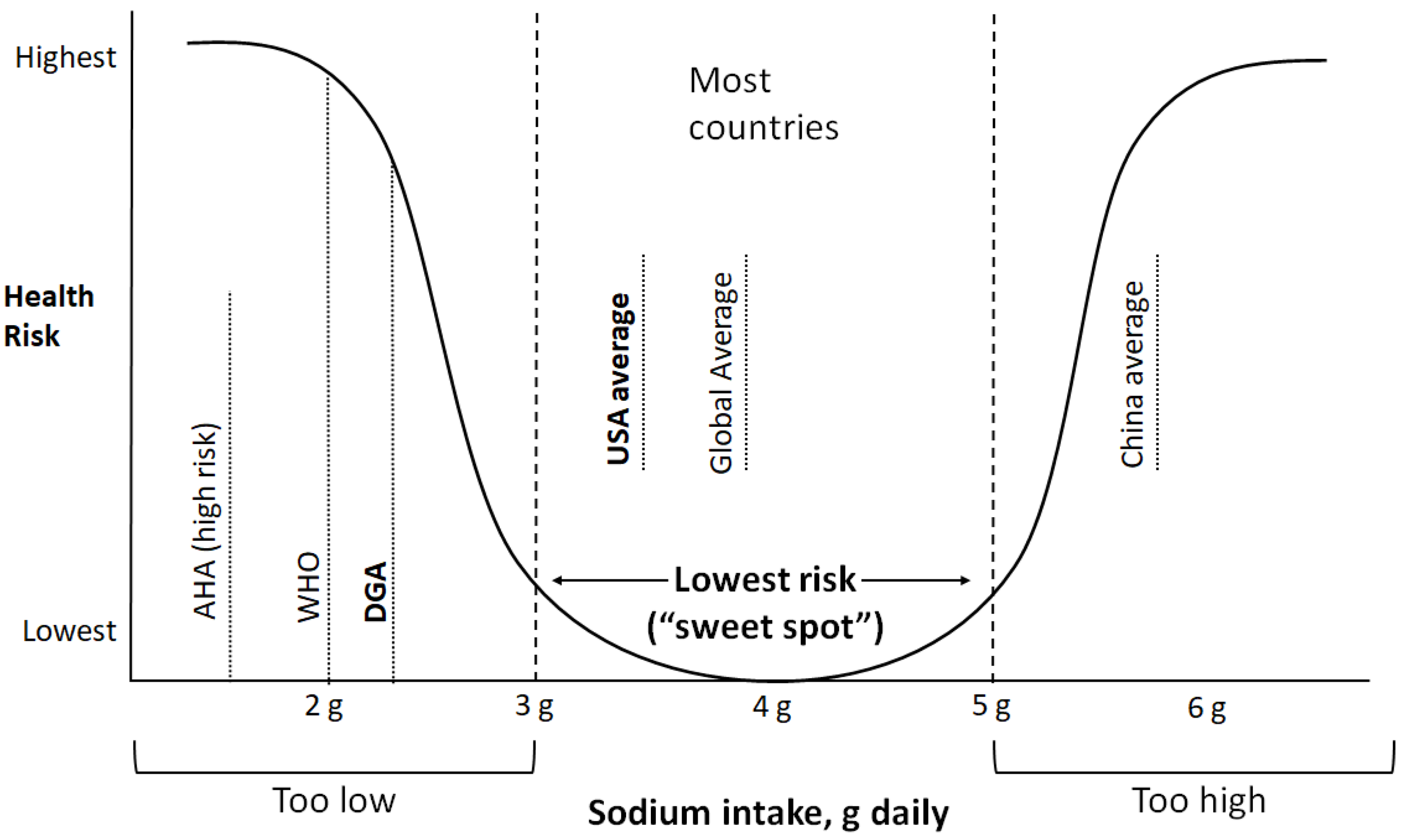
Figure 1. Conceptual diagram of health risk by sodium intake levels based on the current evidence. The lowest risk range (i.e., “sweet spot”) for sodium intake is at ~3 to 5 g/day, with both lower and higher levels of intake associated with higher risk of cardiovascular disease or death. The Dietary Guidelines for Americans (DGA) recommendation for sodium corresponds with a higher risk of adverse health outcomes.
Insulin Is A Bigger Problem For Blood Pressure Than Sodium
Insulin causes the kidneys to retain more sodium and water. In the body sodium and water always follow each other. We’ve been blaming salt while sugar has been the driver of hypertension.
Your kidneys not only filter your blood they also maintain electrolyte balance and control your blood pressure. The renin angiotensin pathway is pretty complex involving your kidneys, liver, and lungs all working to control blood pressure. When the kidneys sense a drop in blood pressure they trigger this multi organ chemical cascade.
Adopting a low carb diet you’re reducing the amount of insulin your body produces through your food choices. There are other things like stress and insulin resistance that can boost insulin levels but when you’re generally making less via food choices you need more electrolytes.
Again, years ago all water was unfiltered and our food contained more minerals. Now our water is filtered and our soils are largely depleted so we’re not getting the minerals we used to get.
How Many Electrolytes Should You Drink In A Day?
This is a very individual answer. It depends on you, your activity level, your eating style, and your current health circumstances.
I suggest starting with one serving per day and see how it goes. If you drink too many you’ll likely find yourself on the toilet with diarrhea.
Try not to chug them first thing in the morning on an empty stomach because they’ll likely go right through you too.
I drink mine before I do something active. Before taekwondo class, before a hike or skiing, and sometimes later in the afternoon if I haven’t had any for the day. Magnesium helps support a good night’s sleep.
A client of mine was a crossfitter who had these rock hard muscles that were difficult to massage. He’d come in for an appointment, I’d overwork myself to release his muscle tension and he’d come back the next week just as tight telling me about all of his jimminy-jams and super doopers - or whatever those crossfit moves are called… One day I asked about electrolytes and he said he didn’t drink any.
The next week he came back telling me how he had better flexibility, his workout felt easier, and his muscles were no longer rock solid because he’d been drinking electrolytes before heading to the gym.
Your muscles and nervous system work somewhat like a battery in that they need minerals and water to conduct ions to function optimally.
Water Quality Matters
I’m sure you already know this but clean water is what you want to drink. Water in plastic bottles is NOT what you want to drink. Our body doesn’t have an efficient mechanism to detoxify itself from all of the plastics we now consume. We’ll lose some through defecation but they’re now finding these plastics accumulate in the brain.
You want a stainless steel water bottle or glass to minimize your plastic consumption. I was gifted a Yeti one year for Christmas and it’s my water bottle because there are no plastic straws. It’s a stainless steel water bottle with a glass spout. I’m seriously in love with this thing. I know they’re spendy but one is all you need.
Tap water contains all sorts of potential body offenders like prescriptions, fluoride, glyphosate, heavy metals, PFAS, and a number of other things.
A reverse osmosis filtration system will remove all of these contaminants but it also removes all of the essential minerals that may be present. If you have one of these filters you definitely need to add minerals to your water unless you get one with a remineralization feature.
There are some water filters that remove harmful contaminants but allow the minerals to remain. Berkey is a popular water filter that does this. I have an Aquagear pitcher that does the same at a fraction of the price, and it takes up less space. I don’t love that it’s a plastic pitcher but after filtering the water I pour it into a glass pitcher or quickly use it for something so the water isn’t left sitting in plastic. Even then, it’s been in contact with plastic for a much shorter period of time than those plastic water bottles.
Electrolytes I’ve Used
I’d say Ultima is the brand I’ve bought most because I can find it locally. Orange and lemon have been our favorite flavors. The Orange mixed with B.rad whey and creatine makes a good pre-workout drink that tastes like an orange cream-sickle.
I had an LMNT subscription for awhile. When you subscribe through LMNT you’ll get occasional perks like hats, stickers, and a sample of new products. I like their electrolytes but per serving they’re a bit more expensive.
Redmond Re-lyte is another brand I’ve tried. I bought the lemon-lime flavor but I wasn’t crazy about it because to me it tasted too sweet. While none of these brands are sweetened with sugar I still don’t like an overly sweet taste.
The easiest budget electrolyte recipe:
1 quart mason jar filled with water
1/4 tsp of salt like Redmonds Real Salt (or any salt that contains trace minerals)
1/4 tsp of potassium chloride
squeeze of lemon or lime
*I swallow the magnesium capsule separately otherwise you’ll make a precipitate at the bottom of the jar that’s hard to clean out.
There’s something about adding potassium chloride to water that makes it next level delicious.
What does your hydration look like? Tell me in the comments below.
