

Perimenopause and Changing Muscle Stiffness: What Helps

Table of Contents
Why Muscle Stiffness Shows Up in Perimenopause
What the Word Perimenopause Actually Means
Estrogen and Muscle Recovery: What Changes and Why It Matters
Perimenopause Muscle Pain: Stiffness, Aches, and the Tissue Story
Sleep and Muscle Recovery in Perimenopause
Protein and Muscle Mass in Midlife: Why Women Undereat
Movement, Stretching, and Load: What Actually Helps Stiff Tissue
A Simple Daily Mobility Sequence
Your Body Is Giving You Information: Investigating the Patterns
When to Talk With a Healthcare Professional
Conclusion: Staying Curious About Changing Muscle Stiffness
Frequently Asked Questions
Why Muscle Stiffness Shows Up in Perimenopause
If you are waking up stiff, sore, and slower to get moving than you were five years ago, you are not imagining it. Perimenopause and changing muscle stiffness are connected, and the connection is more interesting than most people are told. This guide looks at what is actually shifting in your tissue, and why the standard explanation of "you're just getting older" leaves so much out.
The word itself is revealing. "Menopause" comes from the Greek men (month) and pausis (cessation). "Peri" is Greek for "around." So perimenopause literally means "around the cessation of the monthly cycle." The term only entered common medical use in the mid-twentieth century, which tells you something important: women lived through this transition for thousands of years before anyone named it, and they did it without a prescription.
That history matters. Estrogen therapy was first developed for women who had complete hysterectomies, a surgical situation where hormone production drops abruptly. Over time, the industry widened the market, and hormone replacement began being marketed to all women going through the transition, not just surgical cases. Many women find relief with medical support, and that is a legitimate choice. But the marketing expansion is worth noticing, because it shifted the question from "what does this woman need?" to "what do we sell women at this age?"
What the Word Perimenopause Actually Means
Perimenopause is the transitional phase before menopause, when ovarian hormone production becomes irregular and eventually declines. It can begin in a woman's late thirties or forties and last for years. Menopause itself is defined retroactively, twelve months after the final menstrual period.
Dr. Elizabeth Bright, a physician who writes about this transition, said bluntly at Keto-Con, "perimenopause isn't real." Her argument is that the symptoms we attribute to a hormonal phase are largely a metabolic condition driven by excess carbohydrate consumption. That is a strong claim, and the evidence is mixed.
But it is a useful question to sit with given that only 12% of American’s are metabolically healthy. Why would a natural transition occur easily when the rest of the health equation isn’t performing optimally?
Get Dr. Bright’s Book On Amazon (affiliate)
Estrogen and Muscle Recovery: What Changes and Why It Matters
Estrogen and muscle recovery are more tightly linked than most women realize. Estrogen plays a role in collagen production, tendon health, and joint lubrication. When levels fluctuate and fall, connective tissue can lose some of its resilience, and recovery after activity can feel slower. This is why a hike that used to leave you pleasantly tired now leaves you stiff for two days.
Here is the piece that gets left out. The more glucose you have circulating, the more estrogen your body needs to manage it. This is a big part of why you cannot eat and train the way you did in your twenties. Your body is not failing you. It is responding to a different input load.
Cutting calories and doing excessive exercise makes this worse, not better. Both overtax the adrenal glands, which are supposed to help pick up some of the slack as ovarian estrogen production declines. When the adrenals are running on empty, the whole system struggles. You can read more about how individual women experience wildly different transitions in Nutrition with Judy's breakdown of why some women have horrible perimenopause.
Perimenopause Muscle Pain: Stiffness, Aches, and the Tissue Story

Perimenopause muscle pain rarely announces itself as one clean symptom.
It shows up as a body that feels less springy in the morning, a low back that complains after a hike you used to shrug off, or a shoulder that tightens for no obvious reason.
The tissue story behind that shift involves several mechanisms running at once, and understanding them changes what you do about it.
Start with collagen. Estrogen influences how collagen is produced and how it cross-links, and cross-linking is what makes tissue stiffer versus more pliable. When estrogen fluctuates and falls, connective tissue can lose some of its elastic quality, and tendons and fascia that once glided now feel like they grip. This is not damage. It is a change in material properties, and material properties respond to load, hydration, and movement.
Then there is glycation, which almost nobody connects to stiffness. Glycation is the process where sugar molecules bond to proteins and form advanced glycation end products, often abbreviated AGEs. Collagen is a long-lived protein, which means it accumulates glycation damage over years. Stiffer, more brittle connective tissue is one result. If your blood sugar has been running high for a decade, some of the stiffness you feel now may have been forming quietly for a long time.
Fascia deserves its own mention here. Fascia is the continuous web of connective tissue that wraps muscle, bone, nerve, and organ. Researchers like John Barnes and Ida Rolf built whole schools of practice around the idea that fascia is not passive packing material but a responsive, innervated tissue. When it loses hydration and glide, the whole body can feel tighter, and the tightness rarely stays where it started. A restricted hip can pull on the low back. A tight diaphragm can refer into the neck and shoulders. The place that hurts is not always the place that needs attention.
Muscle protein synthesis is the fourth piece. Older muscle responds less efficiently to the same protein intake and the same training stimulus, and lower estrogen appears to make that worse. This is one reason a workout that built you at 28 maintains you at 48. It is not a character flaw. It is a different physiological input-output ratio, and it means the dose of protein and load has to change.
Inflammation markers are the fifth. When sleep, blood sugar, and stress are all off at once, the body runs a low-grade inflammatory tone that makes everything feel stiffer. Seed oils high in linoleic acid, refined carbohydrates, and chronic stress all feed that tone. So does poor circadian alignment, because inflammatory signaling follows the body's clock.
There is also the matter of what you are eating. Plant compounds called lectins, phytates, and oxalates cause trouble for some people and not others. Nightshades and histamines are similar. These are not universally bad, but if you are doing everything right and still aching, they are worth investigating as individual variables rather than dismissing. Autoimmune Paleo is one framework that removes them systematically to see what changes.
What ties all of this together is that stiffness is not one thing. It is a signal that could be coming from collagen quality, blood sugar, fascia hydration, protein sufficiency, inflammation, or a food trigger. Your experience is worth investigating, because the answer for you is probably not the answer for the woman next to you in the grocery line.
Sleep and Muscle Recovery in Perimenopause
Sleep and muscle recovery in perimenopause are almost impossible to separate. When you cannot sleep, you cannot recover. Tissue repair, hormone production, and inflammation control all depend heavily on deep sleep, and this is the stage that tends to fragment first in the transition years.
The cascade is predictable and frustrating:
Poor sleep raises cortisol levels
High cortisol further taxes the adrenals
Fatigued adrenals make hormonal production harder
Lower hormonal support worsens sleep
The loop tightens
Vasomotor symptoms like hot flashes and night sweats interrupt sleep directly. So does a blood sugar crash at 3 a.m. if you ate a high-carb dinner. Many women find that shifting toward fat and protein as the base of their meals steadies overnight blood sugar and, in turn, sleep. When sleep improves, post-exercise soreness and morning stiffness often improve with it.
Pro Tip: If you wake at 3 a.m. with a racing mind or night sweats, look at your last meal before you look at your mattress. A dinner built on animal protein and fat instead of bread or pasta changes overnight blood sugar for many women, and better blood sugar often means fewer wake-ups.
Protein and Muscle Mass in Midlife: Why Women Under Eat
Protein and muscle mass in midlife is where I see the biggest gap between what women believe they are doing and what they are actually doing.
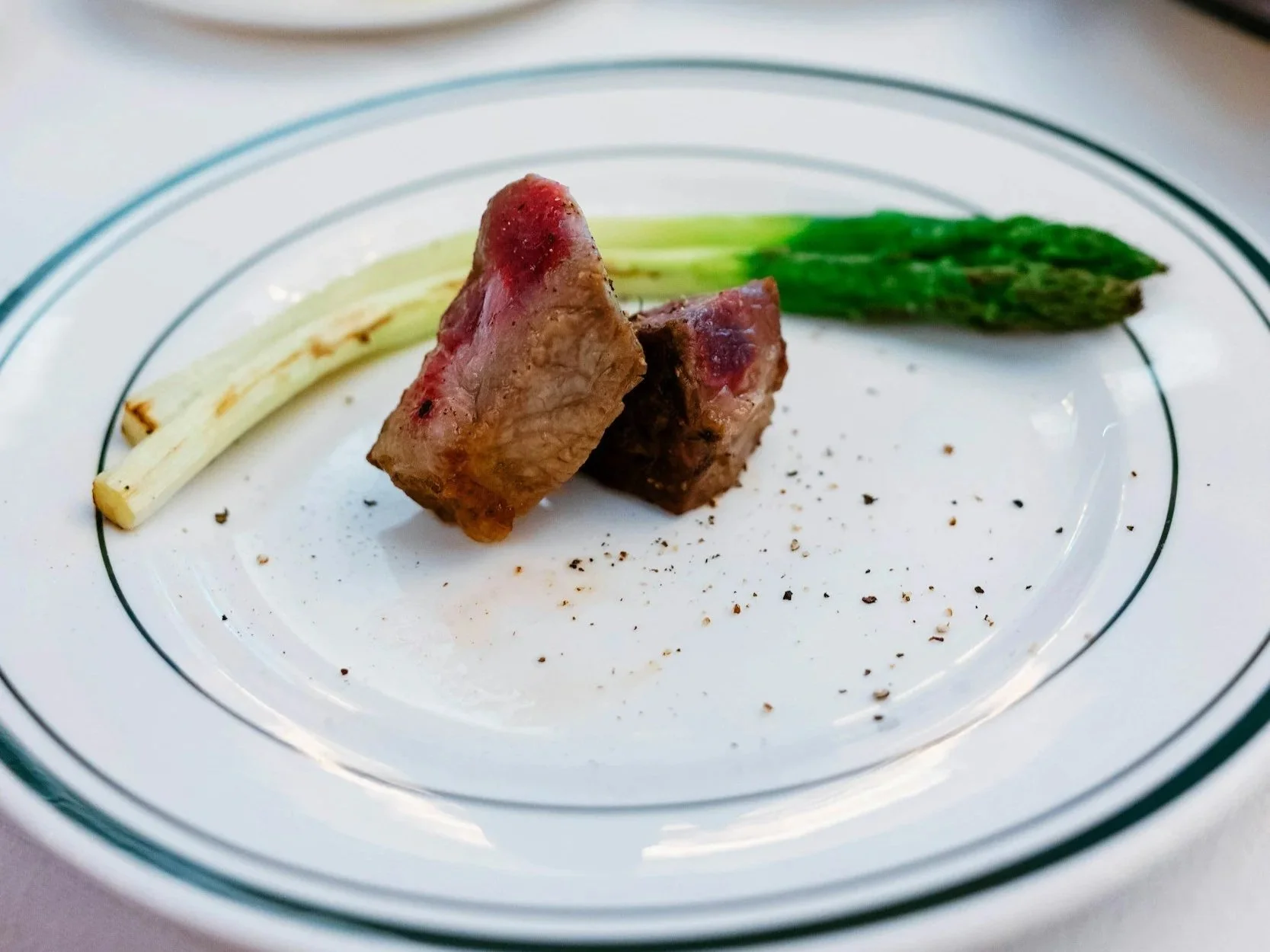
Most women over 35 are not eating enough animal protein to sustain muscle mass, and they have been told for decades that this is fine.
It is not fine. Muscle mass is a place where the body stores glucose. The more muscle you carry, the more glucose you can clear, and the less estrogen your body needs to manage it. Muscle also supports bone density, which matters enormously as bone loss accelerates. Sarcopenia, the age-related loss of muscle, is not inevitable, but it is very common, and it is accelerated by under-eating protein and over-doing cardio.
Plant proteins are not equivalent to animal proteins for this purpose. They come with lower bioavailability, different amino acid profiles, and often a load of the plant compounds mentioned earlier. This does not make them useless. It makes them a different tool.
Here is the uncomfortable part: many women are becoming frail by chasing the scale. Body composition and weight loss are not the same thing. Losing ten pounds by eating less and walking more often means losing muscle, which makes you weaker, stiffer, and more prone to injury. The purpose of exercise is longevity, not weight loss.
Watch Out: Cutting calories hard while increasing cardio is the most common mistake I see in women over 40. The scale moves, but so does your muscle mass, and your adrenals take the hit. The result is more stiffness, worse sleep, and a body that feels older than it is.
Movement, Stretching, and Load: What Actually Helps Stiff Tissue
Most advice for perimenopausal stiffness says some version of stretch more and stay active. That advice is not wrong, but it is incomplete, and it misses the two things that actually change stiff tissue: load and recovery. Let me explain why, because the why is what makes the difference between a routine that works and one you abandon by week three.
The Other 23 Field Study | Health Coaching for Women 40+ | Meridian, Idaho →
Passive stretching changes tissue less than people expect. When you hold a hamstring stretch for thirty seconds, you are mostly signaling the nervous system to tolerate a longer position, not permanently lengthening the tissue. That signal fades within hours. Load is different. When you lift something heavy or move against meaningful resistance, you create mechanical tension that prompts the tissue to remodel over days and weeks. This is why a session of deadlifts or loaded carries can do more for hip and back stiffness than a month of daily stretching. The tissue adapts to what you ask of it, and it adapts to load more than to length.
A few principles worth knowing:
Load beats stretch. Lifting something heavy, even briefly, changes tissue more than holding a stretch.
Slow beats fast. The nervous system responds to unhurried input, which is why slow deliberate movement often unlocks tissue that fast movement cannot.
Consistency beats intensity. Ten minutes daily outperforms an hour once a week.
Whole-body beats spot work. Stiffness rarely lives in only one place, and chasing the spot that hurts often misses the driver.
Recovery is part of the program. Tissue that is not recovering overnight is not adapting, no matter how good the workout was.
That last point is where perimenopause changes the math. Sleep and muscle recovery are almost impossible to separate, and the deep sleep stage that drives tissue repair is often the first to fragment during the transition years. If you are waking at 3 a.m. with night sweats or a racing mind, your body is not getting the repair window it needs, and no amount of stretching will compensate. This is why I ask about sleep before I ask about a mobility routine. Fixing the recovery window often does more for morning stiffness than adding another stretch.
There is also the workday problem. If you sit at a desk for eight hours, your hip flexors and thoracic spine are being held in one position for most of your waking life. No morning routine can fully offset that. The practical fix is to break the position more often, not to stretch harder once. Standing up every thirty to forty-five minutes, doing a few slow thoracic rotations, and taking calls on your feet are small changes that add up. If your job is physical instead, the opposite problem applies: repetitive load without adequate recovery. Either way, the question is what your day is asking of your tissue and whether your inputs match.
This is where individualized bodywork can play a role. I use slow, purposeful strokes and wait for the body to respond instead of forcing my way in. That approach allows deep tissue results while still being deeply relaxing, and it fits into a broader investigation rather than standing alone as a fix. Bodywork can restore glide and range, but it does not replace the load and recovery work that only you can do between sessions.
A Simple Daily Mobility Sequence
This is a starting point, not a prescription. Move slowly and stop if anything sharpens.
Cat-cow, 8 slow reps. Wake up the spine.
Standing hip circles, 5 each direction. Free the hips.
Shoulder rolls and arm swings, 30 seconds. Open the chest and shoulders.
Deep squat hold, 30 to 60 seconds. Restore ankle, knee, and hip range.
Thoracic rotations, 5 per side. Unlock the mid-back.
Calf and hamstring rock, 10 reps. Address the back line.
Neck nods and turns, 5 each. Gentle, never forced.
Standing breath with arms overhead, 5 breaths. Finish with length.
If you want to add load, the simplest entry is a few sets of a basic hinge, a squat, and a carry, done two or three times a week with enough resistance to feel like work. You do not need a gym. You need tension, time, and recovery.
Ten minutes of slow, daily movement does more for stiffness than an intense session once a week. But movement alone is not the whole answer. Load remodels tissue, sleep repairs it, and the position you hold all day shapes it. The body's default program is to heal itself, and your only job is to give it what it needs.
Your Body Is Giving You Information: Investigating the Patterns
Your body is giving you information, and the stiffness is part of the message. The question is whether anyone is reading it. In a fifteen-minute appointment, there is rarely time to ask when the stiffness started, what changed in your diet, how your sleep has been, or what your stress load looks like. So the symptom gets treated and the context gets lost.
I have been licensed to practice medical massage therapy since 2002. My background includes therapeutic massage, Myoskeletal Alignment, myofascial techniques, neurodynamics, craniosacral therapy, anatomy and physiology, environmental science, nutrition, movement, and Certified Primal Health Coaching. That mix is deliberate. It lets me look at the whole person rather than automatically treating the location of the symptom.
For women who want to go deeper, the carnivore diet and hormone balance overview from Hormone Wellness is a useful read. Interestingly, most people who follow a carnivore diet are women, which suggests a lot of women are finding something there that standard advice did not give them.
If you want to explore this with structure, The Other 23: Field Study is a 16-week small-group coaching and bodywork experience for women 40 and up. It covers nutrition, movement, sleep, stress, hydration, sunlight, and lifestyle, and it is built for women who are doing what they believe is right and still do not feel right.
When to Talk With a Healthcare Professional
Talk with a healthcare professional if your pain is persistent, worsening, or comes with red flags. Those include unexplained weight loss, fever, night pain that wakes you, numbness or weakness, or pain after a fall. Stiffness that shows up suddenly and severely also deserves a medical look.
This is not a choice between conventional care and everything else. Conventional care has real value, and it also has limits. Short appointments, generalized recommendations, and fragmented care can leave your individual context unexplored. You can see your doctor and still have unanswered questions. Both things are true.
What I do is not a replacement for medical treatment. Bodywork, nutrition, and lifestyle changes work alongside the care you already receive. My role is to help you ask better questions, notice patterns, and investigate what might be relevant to your situation. Information is useful. Knowing what to do with it is different.
Conclusion: Staying Curious About Changing Muscle Stiffness
Maybe it is not your age. Maybe the stiffness you are feeling is a signal that something in your inputs has changed, and your body is asking for a different approach than the one that worked at 25. Your body is not broken. It is responding, and it is giving you information worth investigating.
The stiffness you are waking up with is not a life sentence, and it is not proof that you are falling apart. It is a pattern worth investigating, and you do not have to do it alone.
Frequently Asked Questions
Why are my muscles so tight in perimenopause?
Declining and fluctuating estrogen affects connective tissue, tendon health, and joint lubrication, which can leave muscles feeling stiff and slow to recover. At the same time, poor sleep, higher circulating glucose, and undereating protein all reduce the tissue's ability to repair. Dr. Elizabeth Bright frames perimenopause as a metabolic condition driven largely by excess carbohydrate intake, which means the stiffness you feel may be tied as much to what you eat and how you sleep as to your ovaries.
Can poor sleep make muscle aches and stiffness feel worse?
Yes. Sleep is when the body repairs connective tissue and clears metabolic waste from muscle. When sleep and muscle recovery in perimenopause are disrupted by night sweats or cortisol surges, the repair window shrinks, post-exercise soreness lingers, and stiffness feels worse the next morning. This is why fixing sleep often shifts pain more than any single stretch or supplement.
Does stiffness go away after menopause?
For some women it eases once hormones stabilize, but for many it does not if the underlying drivers are never addressed. Protein intake, muscle mass, blood sugar, sleep, and movement patterns all shape how tissue feels long after the transition ends. If you have been told to just wait it out, that is worth questioning.
How can I tell whether muscle stiffness is related to perimenopause?
Look at the pattern, not just the symptom. Stiffness that arrived alongside irregular cycles, night sweats, or changing body composition is more likely tied to the transition. Stiffness that comes with swelling, redness, or loss of function needs a medical evaluation. Tracking sleep, protein, and activity alongside your symptoms gives you information a short appointment rarely has time to gather.
