

Table of Contents
The Scale Measures a Number, Not a Body
Calorie Restriction Long-Term Weight Loss Failure and the Nutrient Cost
Muscle Loss in Women Over 50 Is the Real Problem
GLP-1 Muscle Loss: What the Research Shows
Strength Training for Bone Health in Women
When Muscle Mass Declines, Muscle Tension Increases
Start With a Coaching Conversation
Frequently Asked Questions
The Scale Measures a Number, Not a Body
I have spent 24 years with my hands on women's bodies, and I can tell you what a scale cannot: what you're made of matters more than what you weigh. I've worked with women in their fifties and sixties who hit a goal weight and still cannot rise from the floor without help. Their sleep is wrecked, their mood is flat, and their digestion has never recovered.
That is not optimum health. That is a smaller version of the same problem.
Chasing the scale leads to frailty in women because the scale counts mass. It cannot tell you whether you have the strength to catch yourself when you trip. And it cannot tell you that the diet that got you here quietly stripped the raw materials your body needs to hold itself together.
Below, I'll show you why the number on the scale is the wrong target, what muscle and bone actually do for each other, and what the research says about the drugs and diets women are told will fix everything.
Calorie Restriction, Long-Term Weight Loss Failure, and the Nutrient Cost
The long-term data on calorie restriction is not ambiguous, and it is worth naming the actual trials instead of gesturing at them. The women’s health initiative study is one of the longest running research studies. Looking at weight loss 48,000 (give or take) participants were given the following dietary direction:
reduce total dietary fat to 20% and increasing intake of vegetables and fruit to 5 or more servings and grains (whole grains encouraged) to 6 or more servings daily.
Below you can see the long term weight loss for women of varying ethnicities over time.
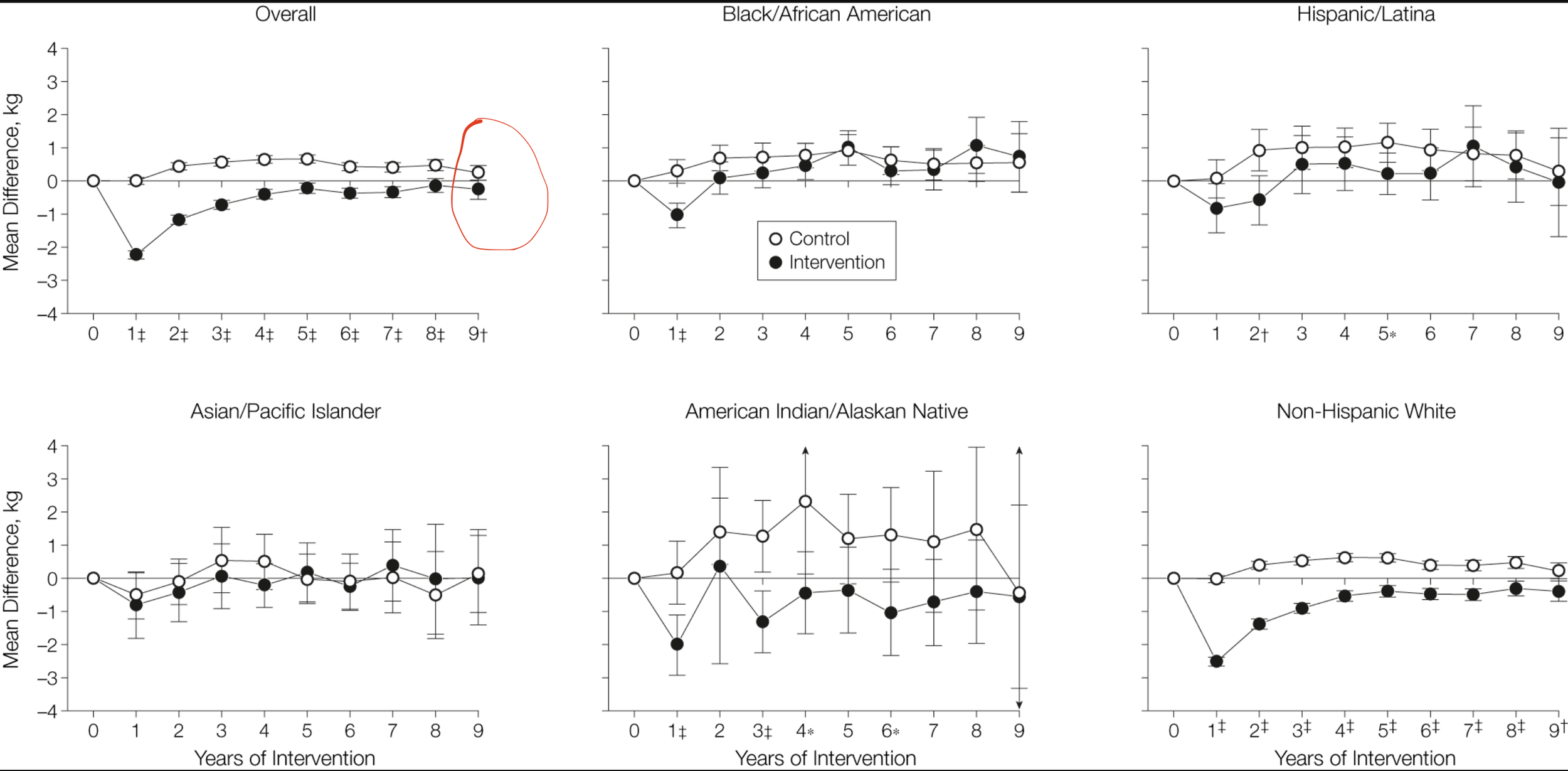
Women’s health initiative study:
Reduced caloric intake 350 calories / day
Over 7 years they lost 0.25 pounds!!
This is one of the reasons I become absolutely infuriated by people following this same dietary advice in pursuit of health. Heck, the study carefully says that a low fat diet doesn’t cause weight gain. Well, from the image above it doesn’t cause weight loss either.
Weight loss is hormonal, not caloric. That sentence sounds like a slogan until you look at what actually moves. When you cut calories hard, insulin falls, ghrelin rises, leptin falls, and circulating thyroid hormone can drop as the body downshifts energy expenditure. Resting metabolic rate falls further than the loss of tissue alone would predict, a phenomenon researchers call adaptive thermogenesis.
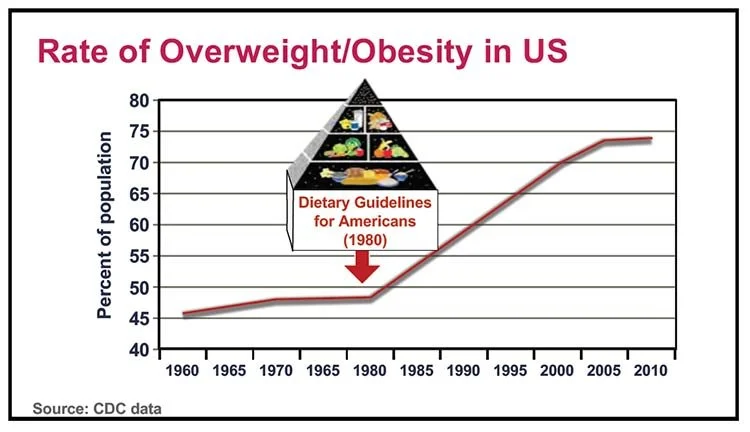
What’s even worse, as your hunger hormones increase and satiety hormones decrease, society blames you for not having enough willpower. “You must not want it bad enough.” Yet this is the reality of the dietary guidance used in the study above:
There is a second cost of weight loss most women never hear about. When you cut calories, you cut nutrients with them, and the nutrients you lose first are often the ones holding muscle, bone, and hormone production together.
Less protein means fewer amino acids for muscle repair and less raw material for the glutathione and enzyme systems that depend on them
Less fat means fewer fat-soluble vitamins, less cholesterol for steroid hormone production, and fewer of the fatty acids that support cell membranes
Fewer total foods means fewer minerals, and calcium, magnesium, and phosphorus intake often fall together, which is exactly the wrong direction for bone
Lower intake frequently means lower iron, zinc, and B vitamins, and iron and zinc are both required for thyroid hormone production and conversion
Long dieting histories are associated with lower bone mineral density in women, particularly when protein and calcium intake fall alongside calories
You can lose weight and lose your foundation at the same time. If you recognize your own history in this, I wrote a separate piece on why your weight loss attempts didn't work that goes deeper into the hormonal side.
Watch out: the failure rate of calorie restriction is not an argument for eating without structure. It is an argument for changing what you cut. Cutting refined carbohydrates and ultra-processed food while keeping protein and fat high is a different intervention than shrinking portions of everything, and the hormonal response is different too.
Here is what the major calorie-restriction trials actually found, and what cutting calories cuts along with them.
97% of dieters regain weight plus more (slate.com)
95% failure rate among dieters
99% failure rate (dietdoctor.com)
Muscle Loss in Women Over 50 Is the Real Problem
Muscle loss in women over 50 accelerates with every passing decade, and menopause speeds it up. Estrogen supports muscle and bone, and when it declines, both tissues lose a key signal.
Start with bone, because most women think of it as a static scaffold and it is anything but. Bone is continuously remodeling through two cell types working in balance (Osteoblast-Osteoclast Communication and Bone Homeostasis). Osteoblasts build new bone by laying down mineralized matrix.
Mechanical load is the signal that drives the balance toward building. When muscle contracts and pulls on bone, the strain is sensed by osteocytes embedded in the matrix, and those cells signal osteoblasts to lay down new bone while restraining osteoclast activity.
Here is what the scale misses. Muscle is your metabolic tissue. It stores glucose, supports insulin sensitivity, and burns energy at rest. Bone is your structural tissue. Together they form a system, and that system is what keeps you upright, independent, and out of a care facility at 80.
A woman who has dieted her way to a lower weight often has less tissue to work with. Her shoulders sit differently. Her grip is weaker. For the deeper physiology on how animal protein supports these tissues, read animal protein for bone and muscle health. (Source: research linking GLP-1 medications to muscle loss)
Watch out: the strength work that builds bone is not the same as the light dumbbell routine most women are handed. Bone responds to load it has not adapted to, which means progressive resistance, real weight, and enough protein and calories to actually build tissue.
GLP-1 Muscle Loss: What the Research Shows
GLP-1 medications cause weight loss, and a meaningful share of that loss comes from lean tissue. Research published on GLP-1 receptor agonists has documented significant reductions in lean body mass alongside fat loss, and the NIH PubMed database on GLP-1 and lean mass holds the primary studies. I am not going to soften this. If you lose weight rapidly on a GLP-1 drug without resistance training and adequate protein, you are likely losing muscle.
The crazy part. If you came to me with a weight loss goal the first thing I’d suggest is lifting heavy weight and eating adequate animal protein. There is no free lunch. If you want to age well and maintain metabolic health the answer is lifting heavy weights and eating animal protein.
That matters more for women over 50, who already face an uphill battle against sarcopenia. A smaller body with less muscle is a more fragile body. It is not a healthier one.
I'm feeling this in my practice right now. Women are thinner than they were, and they are weaker than they have ever been. If you are on or considering a GLP-1 medication, this coaching article on health coaching for women over 40 with muscle aches addresses the body changes directly.
Strength Training for Bone Health in Women
Bone is not a static scaffold. It is living tissue, constantly remodeled by two cell types working in balance.
Osteoblasts build new bone by laying down mineralized matrix
Osteoclasts break down old bone, releasing minerals into the blood
The two together maintain bone homeostasis, replacing worn tissue with fresh
Mechanical load drives that balance. When muscle pulls on bone, osteoblasts get the signal to build. When load disappears, osteoclasts win and bone density falls. This is why strength training for bone health in women is not optional. Heavy resistance training, the kind that loads the spine and hips, is one of the few inputs that reliably pushes the system toward bone formation.
Walking helps. Lifting helps more. Muscle keeps bones strong, and bones keep you standing.
When Muscle Mass Declines, Muscle Tension Increases
As muscle mass declines, muscle tension increases. That is the practical definition of frailty, and it is what I feel under my hands. Weak tissue cannot share the load, so the remaining fibers work harder and stay switched on. The nervous system keeps them guarded. The result is a body that feels tight, achy, and stiff, not because it is damaged but because it is compensating.
Research on muscle weakness and increased passive tension supports a link between low strength and higher resting tension in aging muscle.
This is where my bodywork fits. My work is slow and purposeful, informed by anatomy and responsive to how your nervous system answers. Alignment, myofascial release, neurodynamics, and craniosacral therapy are among the approaches used in my work to help the body release guarding it no longer needs. I do not force tissue, and I do not treat the spot that hurts as the whole story. Massage can help with muscular tension and movement restrictions, but it works best alongside the nutrition and strength work that rebuild the tissue itself.
I’m finding that working on GLP-1 muscle wasting is a challenge. Muscles are fibrous and they don’t respond easily to massage. And people complain about recurring pain and tension in muscles that have grown weak. It’s why I aim to support people with nutrition and lifestyle habits.
Since muscle plays a key role in metabolism and body composition, the clap back when people stop these meds isn’t going to be pretty.
Start With a Coaching Conversation
Here is the challenge I put to every woman who comes to me chasing a number: stop asking how much you weigh and start asking what you're made of.
If you suspect you are doing what you believe are the right things and still feel frail and/or the scale won’t move, the answer is not another calorie cut. It is a closer look at protein, strength, sleep, light, and the habits underneath them. That is exactly what health coaching is for, and my 16-week small-group coaching and bodywork experience, The Other 23: Field Study, is built for women 40 and older who are ready to investigate the gap between what they're doing and how they feel.
Frequently Asked Questions
Can dieting cause muscle loss in women?
Yes. When calories drop sharply, the body pulls energy from both fat and lean tissue, and muscle is expensive to maintain. Research on calorie-restricted diets shows a meaningful share of the weight lost is lean mass, not fat. For women over 50, who are already losing muscle through hormonal shifts, that loss accelerates frailty. Adequate protein and resistance training help protect muscle, but the first move is to stop treating a lower number on the scale as the goal.
Do GLP-1 medications cause muscle loss?
Research on GLP-1 medications shows that a substantial portion of the weight lost is lean mass, including muscle. Because these drugs suppress appetite, many users also eat far less protein, which compounds the problem. The result can be a smaller body with less strength, lower bone density, and worse metabolic health. Anyone using these medications should discuss protein intake and resistance training with their provider rather than focusing on the scale alone.
What is the relationship between muscle weakness and muscle tension?
Weak muscles fatigue quickly and compensate poorly, so surrounding tissues tighten to stabilize joints and protect against strain. That guarding pattern shows up as chronic tension in the neck, shoulders, and lower back. Research on muscle function links low strength to altered movement patterns and increased tone. In general, tissue can feel tight when the muscle underneath cannot do its job.
Why can weight loss become harder during menopause?
Estrogen decline changes where the body stores fat, reduces muscle protein synthesis, and shifts insulin sensitivity. A calorie deficit that worked at 35 often produces muscle loss and stubborn fat retention at 55 because the hormonal signal has changed. Weight loss is hormonal, not simply caloric. Supporting protein intake, strength training, sleep, and blood sugar stability addresses the physiology instead of fighting it with a smaller plate.
